Malaysia’s slight decline in approved investments in the first quarter of 2026 (1Q26) should not be viewed as a concern, but rather as a reflection of a more selective investment strategy focused on quality and long-term economic value, according to OCBC Senior ASEAN Economist Ms Lavanya Venkateswaran.
Her comments came following the release of data by the Malaysian Investment Development Authority (MIDA), which showed Malaysia secured RM92.8 billion in approved investments in 1Q26, slightly below the RM93 billion recorded in the same period last year.
The approved investments involved 1,249 projects across the services, manufacturing and primary sectors and are expected to create 50,226 new jobs.
While the overall value of approved investments eased marginally year-on-year, Venkateswaran said the performance demonstrated resilience amid continued global economic uncertainty.
“We do not see this as worrying but as a sign of resilience. Indeed, it is consistent with our long-held view that the authorities aim to attract quality investments going forward,” she said.
She noted that Malaysia’s investment authorities are increasingly prioritising projects that contribute towards raising manufacturing value-add and moving industries higher up the global supply chain.
“The authorities are willing to tolerate reduced investments, rejecting applications that do not fit with the medium-term objective of raising manufacturing value-add and moving up the supply chain,” she added.
Foreign investment remains a key driver
Foreign investments continued to dominate Malaysia’s approved investment landscape, contributing RM56.2 billion or 60.5% of total approvals.
Domestic investments, meanwhile, rose 13% year-on-year to RM36.6 billion, reflecting continued confidence among local businesses.
Japan emerged as the largest source of approved foreign investments with RM21.5 billion, a significant increase from RM1.6 billion a year earlier.
Other major contributors included China and the United States with RM10.1 billion each, followed by Singapore at RM6.7 billion and Thailand at RM2.5 billion.
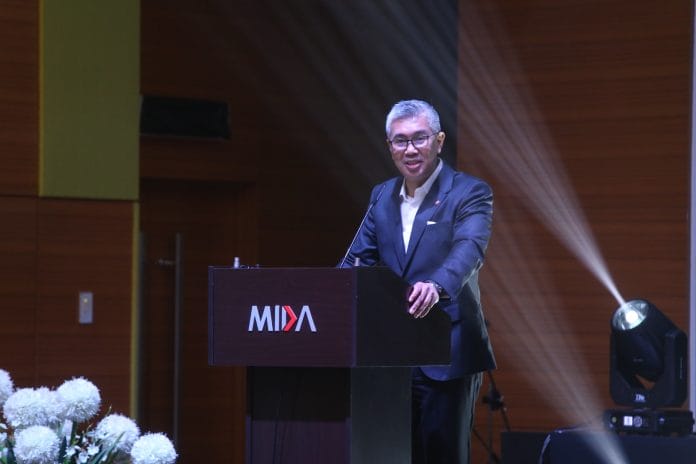
MIDA Chairman Tengku Datuk Seri Zafrul Tengku Abdul Aziz said the investment performance highlighted Malaysia’s appeal as a strategic regional hub.
He said the country continues to attract investments aligned with technology, resilience and future growth sectors despite global challenges.
Digital infrastructure and manufacturing lead inflows
The services sector remained the largest contributor, accounting for RM60.8 billion or 65.5% of total approved investments.
Information and communications activities dominated the sector with RM38.9 billion, driven mainly by data centre and cloud computing projects.
Data centre and cloud-related investments accounted for RM34.6 billion across 33 projects, supported by rising demand for artificial intelligence (AI) infrastructure and digital transformation.
The manufacturing sector attracted RM24.1 billion across 501 projects and is expected to create 30,468 jobs, with major contributions from electrical and electronics, chemicals, machinery and equipment, food manufacturing and transport equipment industries.
The primary sector recorded RM7.9 billion in approved investments, supported by oil and gas exploration and development activities, particularly in Sarawak.
Malaysia remains on track for positive FDI inflows
Looking ahead, Venkateswaran said OCBC continues to expect Malaysia to record positive net foreign direct investment (FDI) inflows for the full year 2026.
“For full year 2026, we still expect net FDI inflows into the economy,” she said.
She added that Malaysia’s ability to attract investments would depend on its continued focus on high-value industries, policy clarity and efforts to strengthen its position within regional supply chains.