


Asian markets surged on Tuesday, led by major technology and semiconductor markets, after reports of a preliminary US-Iran peace agreement eased concerns over energy supply disruptions and inflationary pressures.
Regional equities advanced strongly, with South Korea’s benchmark index leading gains with a 5.2% jump, followed by Japan at 5.0% and Taiwan at 3.0%. The rally was driven by renewed investor appetite for technology and artificial intelligence (AI)-related stocks, alongside expectations that a potential reopening of the Strait of Hormuz could reduce geopolitical risks.
Sentiment improved after Brent crude prices fell nearly 5% amid hopes that the strategic waterway, a key route for global oil shipments, could resume normal operations. Lower energy prices raised expectations that inflationary pressures may ease and reduce pressure on central banks to maintain tighter monetary policies.
The optimism was further supported by strong investor interest following the debut performance of SpaceX, which reportedly extended its post-listing gains and boosted demand for high-growth technology names.
On Wall Street, major indices continued their upward momentum, with the Dow Jones Industrial Average rising 0.92%, the S&P 500 gaining 1.66%, and the Nasdaq climbing 3.07%.
Meanwhile, Brent crude prices declined 4.7% to around US$83 per barrel, while the US 10-year Treasury yield eased one basis point to 4.47%.
Investors are now turning their attention to the Federal Reserve’s upcoming policy direction under new Chair Kevin Warsh on June 17, with markets watching how policymakers balance inflation risks, economic conditions and political pressure.
KLCI Extends Fourth Consecutive Session of Gains
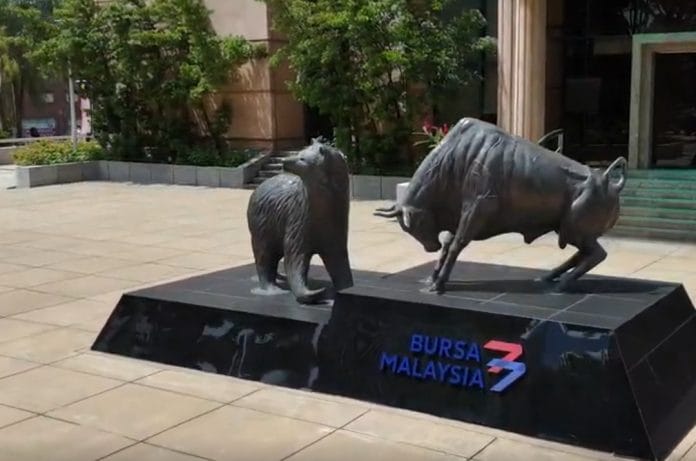
In Malaysia, the FBM KLCI rose 0.46% to close at 1,691.4 points after reaching an intraday high of 0.82%. The local benchmark extended its gains for a fourth straight session, supported by buying interest in key heavyweights including CIMB Group Holdings Bhd, Malayan Banking Bhd (Maybank), Public Bank Bhd, YTL Corporation Bhd, Sime Darby Bhd, Hong Leong Bank Bhd and 99 Speed Mart Retail Holdings Bhd.
Market breadth improved, with advancing counters outnumbering declining stocks at a ratio of 1.67, compared with 0.91 previously. Trading activity strengthened significantly, with total volume increasing 72% to 5.02 billion shares worth RM3.91 billion, up 68% from the previous session.
Local institutional investors extended their buying streak for the 20th consecutive session, recording net inflows of RM173 million. Their five-day net inflow stood at RM501 million, while month-to-date inflows reached RM1.41 billion.
Foreign funds also turned marginal buyers with RM13 million in net inflows, ending a 21-session streak of selling. Retail investors, however, emerged as net sellers with RM186 million in outflows.
Technical Outlook Remains Cautious
Despite the recent rebound, analysts noted that the KLCI remains in an extended corrective phase after forming a double-top pattern and falling below its key moving averages.
Immediate support is seen at the 1,670 level, which represents the 200-day moving average. A break below this level could expose the index to further downside towards 1,650, 1,625 and 1,600.
On the upside, momentum is expected to remain limited unless the index breaks back above the 1,700 to 1,720 range. A sustained move above this zone could signal a trend reversal and open the path towards 1,732 and 1,750.
The near-term outlook for the KLCI is expected to remain influenced by global market movements, particularly ahead of the expected formal signing of the US-Iran peace agreement on June 19.
However, gains may be capped by concerns over softer Malaysian economic growth and corporate earnings momentum in the second half of 2026, reflecting potential delayed effects from months of geopolitical disruptions.
Domestic risk sentiment is also being monitored as Malaysia approaches upcoming state


