


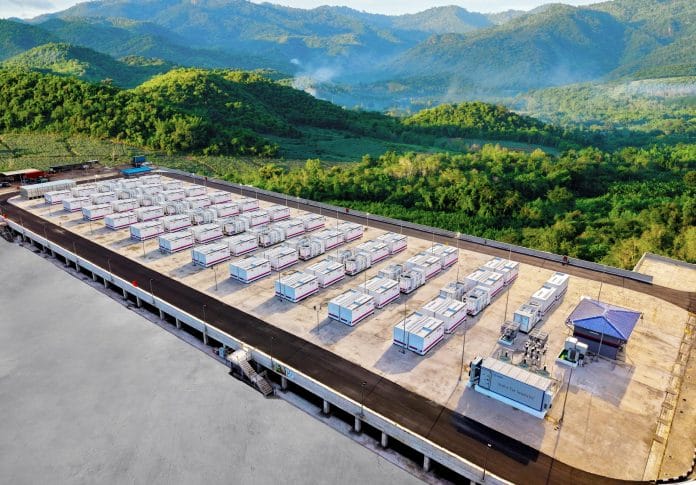
Tenaga Nasional Berhad’s first grid-connected battery energy storage system (BESS) is expected to play a key role in strengthening Malaysia’s power grid as the country accelerates its renewable energy (RE) transition, according to CGS International (CGSI).
The research house highlighted that TNB’s Santong BESS facility in Dungun, Terengganu, represents a significant milestone for Malaysia’s power sector, providing a foundation for future large-scale battery storage deployment.
The 100MW/400MWh grid-forming BESS facility, fully owned by TNB, was commissioned in April 2026 and connected to the national transmission network. The project forms part of TNB’s transmission and distribution (T&D) asset base, with approximately RM380 million in regulated capital expenditure under Regulatory Period 4 (RP4) and an estimated useful life of 21 years.
CGSI said Santong’s grid-forming technology differentiates it from conventional grid-following battery systems, as it can provide voltage reference, frequency regulation and synthetic inertia.
“These capabilities allow the system to support grid stability, power quality, system recovery during outages and peak load management,” CGSI said.
The research house noted that such technology will become increasingly important as Malaysia’s electricity generation mix shifts towards more intermittent renewable energy sources such as solar.
Blueprint for Future Battery Storage Deployment
Beyond its immediate role in supporting grid operations, Santong BESS is expected to serve as a learning platform for TNB to develop technical, operational and commercial expertise in utility-scale battery storage.
TNB management said the experience gained from developing, commissioning and operating the facility would help establish local expertise and deployment frameworks for wider BESS adoption across Malaysia’s power sector.
The company has also entered into a 10-year long-term service agreement with original equipment manufacturer Sungrow to support battery operations and maintenance, including knowledge transfer.
CGSI highlighted TNB’s execution capabilities, noting that the Santong project was completed within 309 days, significantly faster than the typical 18 to 24-month timeline for similar projects.
To address potential flood risks and challenging soil conditions during the East Coast monsoon season, TNB adopted an elevated platform design for the facility.
The achievement demonstrated TNB’s ability to adapt international technologies to local environmental conditions, CGSI said.
Storage Demand to Rise with Renewable Energy Growth
According to CGSI, Malaysia’s future energy transition will require greater investment in grid-strengthening solutions and energy storage.
TNB management indicated that studies suggest Peninsular Malaysia’s grid can currently accommodate around 6GW of renewable energy capacity, compared with the current installed base of approximately 4.5GW.
Beyond that level, additional storage capacity and grid reinforcement measures are likely to be required.
The study estimated that every additional 1,000MW of renewable energy capacity could eventually require around 500MW of battery storage capacity to maintain network stability.
CGSI added that improving battery economics could further accelerate adoption, with battery costs declining while technological advancements continue to improve energy density and reduce land requirements.
Future demand for storage solutions is expected to be supported by renewable energy expansion, electrification trends, electric vehicle (EV) adoption and rising data centre-related electricity demand.
CGSI Maintains “Add” Rating on Tenaga
CGSI maintained its “Add” recommendation on TNB with an unchanged sum-of-the-parts (SOP) target price of RM16.60, naming the utility group as one of its top picks in Malaysia.
The research house said TNB provides investors with exposure to Malaysia’s accelerating energy transition and power sector investment cycle.
At current valuations, TNB trades at 7.6 times 2026 forecast adjusted enterprise value-to-EBITDA, compared with regional power sector peers trading between 9 and 16 times.
CGSI sees potential for further re-rating driven by stronger data centre demand, faster capital expenditure deployment and potential new combined-cycle gas turbine (CCGT) projects.
However, risks include higher operating expenses, fuel price volatility and unfavourable regulatory changes.


