


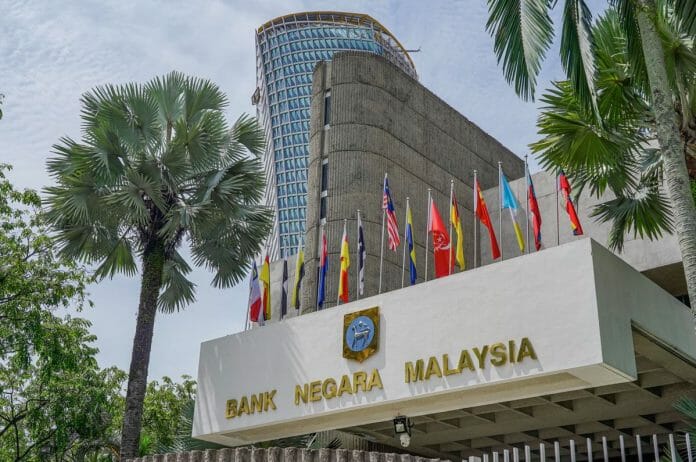
Bank Negara Malaysia’s (BNM) international reserves declined by US$0.5 billion or 0.4% month-on-month (m-o-m) to US$132.1 billion as at July 31, 2026, marking the first monthly decline in four months.
Despite the decline, the reserves position remained sufficient to finance 4.7 months of imports of goods and services, while the reserves-to-short-term external debt ratio was unchanged at 0.9 times.
According to Kenanga, the decline was mainly driven by lower foreign currency reserves, which fell by US$0.4 billion or 0.3% m-o-m to US$116.8 billion.
The research house attributed the decline to what it believed was likely sizeable foreign outflows from Malaysia’s domestic bond market.
Meanwhile, holdings of other reserve assets fell by US$0.1 billion or 5.8% m-o-m to US$2.2 billion, while gold, special drawing rights and the International Monetary Fund (IMF) reserve position remained broadly unchanged.
In ringgit terms, total international reserves declined by RM1.9 billion or 0.4% m-o-m to RM535.1 billion.
Kenanga noted that the ringgit extended its weakness in July, depreciating by a further 0.3% against the US dollar to an average of RM4.08 per US dollar, compared with RM4.07 in June.
The currency traded largely within Kenanga’s projected range of RM4.07 to RM4.10 per US dollar during the month.
According to the research house, elevated Middle East tensions and higher energy prices supported the US dollar, while softer US inflation and labour market data tempered expectations of further Federal Reserve tightening.
The Fed’s decision to maintain interest rates at its July meeting subsequently reinforced expectations of an extended pause, allowing the US dollar to give back some of its earlier gains and helping stabilise the ringgit towards the end of the month.
Across the region, all five ASEAN currencies weakened against the US dollar as the US Dollar Index (DXY) rose to 100.9 in July from 100.3 in June.
The Thai baht recorded the sharpest decline at 1.8%, followed by the Philippine peso at 0.7%, Indonesian rupiah at 0.6%, ringgit at 0.3% and Singapore dollar at 0.2%.
Kenanga said renewed geopolitical tensions and higher energy prices sustained safe-haven demand for the US dollar, although softer US inflation and expectations of an extended Fed pause moderated broader US dollar strength towards month-end.
Looking ahead, Kenanga expects BNM to maintain the Overnight Policy Rate (OPR) at 2.75% throughout 2026, supported by contained underlying inflation and resilient economic growth.
However, the research house said higher producer prices warrant close monitoring for signs of pass-through into consumer prices.
It expects any cost pressures to remain manageable and believes BNM is likely to look through temporary supply-driven shocks and prioritise policy stability unless broader second-round inflationary pressures emerge.
Kenanga maintained its year-end US dollar-ringgit forecast at RM3.95, compared with RM4.06 at end-2025.
The research house said its constructive medium-term view of the ringgit remains intact, viewing the recent US dollar strength as a temporary hawkish detour rather than a fundamental change in direction.
It expects structural factors, including reserve diversification, persistent US fiscal deficits and gradual portfolio reallocation, to regain influence once the Federal Reserve moves beyond its extended pause and begins easing monetary policy.
In the near term, however, Kenanga expects the Fed’s rate pause to continue supporting the US dollar through interest-rate differentials, with renewed downward pressure on the US dollar expected when rate cuts begin.
Kenanga added that Malaysia’s resilient economic growth, sustained current account surpluses and record foreign currency deposits provide supportive fundamentals for the ringgit, with the latter offering scope for future conversion into ringgit-denominated assets.


