


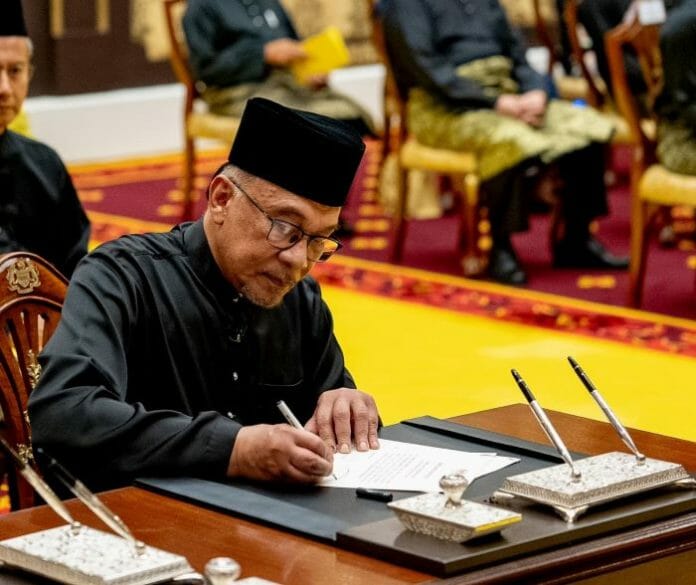
Prime Minister Datuk Seri Anwar Ibrahim must be given a fair assessment. Taking the helm post-pandemic, he inherited a deeply altered global economic landscape fraught with geopolitical conflicts, trade disruptions, volatile energy prices, and relentless cost-of-living pressures.
Malaysia’s economy has by no means failed. Gross Domestic Product (GDP) growth reached 6 per cent in the second quarter of 2026. Yet, strong macroeconomic indicators have not necessarily translated into tangible relief at the kitchen table. This disconnect poses a growing threat to Anwar and Pakatan Harapan (PH).
According to a Merdeka Center survey released in June, Anwar maintains the highest approval rating among national political leaders at 52 per cent. However, 50 per cent of respondents felt the country was headed in the wrong direction, while 73 per cent cited the economy as their primary concern. Recent state election results further demonstrate that Anwar’s personal popularity does not automatically convert into political confidence for PH.
Anwar’s political capital is being steadily eroded not just by his own performance, but by the actions and statements of his Cabinet ministers, PH leaders, and inner circle. Every time a minister or lawmaker delivers a defensive response, dismisses public anxiety, or contradicts ground realities, the Prime Minister bears the cost. A leader cannot be decoupled from the team he appoints and trusts.
Communications Minister Datuk Seri Fahmi Fadzil’s acknowledgment that government achievements have been poorly communicated highlights an ongoing structural issue. Putrajaya cannot simply announce policies and assume public understanding.
Announcements are not communication. The Communications Ministry must articulate policies in clear, accessible terms: what problem is being solved, who benefits, when results will be felt, and what data proves its success. Effective government messaging must move beyond defending decisions or dismissing public discontent.
Furthermore, Anwar must temper grand rally speeches. Voters no longer evaluate leadership on oratorical skill alone. Unrealistic promises only cultivate unmanageable expectations. The Prime Minister should shift away from sweeping pledges toward measurable targets, firm implementation timelines, and publicly verifiable progress reports.
The same principle applies to legacy PH pledges, including the restructuring of PTPTN loan repayments, gradual toll abolishment, and fuel price reductions. While fiscal constraints altered by global economic shifts are understandable, changing circumstances do not justify abandoning past commitments without clear explanation.
The government should establish a public manifesto dashboard outlining the status of every commitment—whether completed, ongoing, deferred, modified, or discontinued—complete with explanations and financial implications. Citizens can accept hard economic truths, but they will not accept silence or shifting goalposts.
Addressing poverty remains as critical as managing cost-of-living pressures. Official data indicates absolute poverty stood at 5.1 per cent in 2024, while relative poverty reached 16.7 per cent. However, welfare data remains fragmented across multiple platforms, including the Implementation Coordination Unit’s (ICU) eKasih system, PADU, the Social Welfare Department (JKM), state agencies, zakat centers, and non-governmental organizations.
To ensure no vulnerable household falls through the cracks, Malaysia requires a National Social Protection Registry to serve as a single source of truth. Rather than centralising raw data onto a single server, Putrajaya should establish a unified household verification system, standardised poverty benchmarks, secure cross-agency data integration, an appeals mechanism, and real-time updates.
Finally, Anwar and PH must confront the issue of leadership transition. If Anwar requires a second term to complete his reform agenda, he must state so clearly while actively preparing the next generation of leadership.
A succession plan is not about crowning an heir apparent; it is about establishing an open, merit-based process that assures the public of PH’s long-term viability beyond Anwar. The coalition cannot continue relying on voter anxiety over alternative political blocs. Reform-minded voters require positive, concrete reasons to maintain their trust.
This is an urgent warning from an electorate that still wishes to see the reform agenda succeed. Time for speeches is running out. The focus must now shift to delivering measurable results, correcting course within the administration, and outlining a clear path for future leadership.
Muhammad Shahrizul Muiz
Anak Pulau Pinang


