


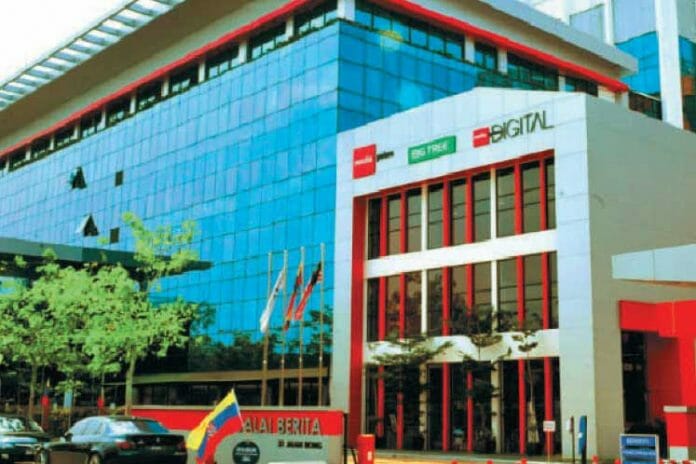
Media Prima Berhad’s earnings outlook has come under increasing pressure from a prolonged advertising expenditure (adex) downturn, prompting Kenanga Investment Bank to downgrade the media group to Underperform from Market Perform.
In a research report, Kenanga said Media Prima’s FY2026 core net profit fell 41% year-on-year (YoY) to RM14.4 million, accounting for 91% of its full-year forecast and 94% of consensus expectations.
The earnings shortfall was primarily attributed to weaker-than-expected adex, while the group maintained its FY2026 dividend per share at 1.5 sen, unchanged from FY2025 and in line with Kenanga’s expectations.
Media Prima’s FY2026 revenue declined 9% YoY, driven by an 11% contraction in advertising revenue across its segments. Digital media adex also fell 3% YoY, with Out-of-Home being the only segment to register growth.
The weakness was particularly pronounced in the fourth quarter, when quarterly adex dropped to RM135 million, its lowest level since the second quarter of FY2020, when adex stood at RM132 million amid the onset of the Covid-19 pandemic.
Kenanga noted that the decline in core earnings was sharper than the revenue contraction, reflecting Media Prima’s high fixed-cost base. This more than offset the benefits from lower depreciation and finance costs.
There were some positive developments, with content sales rising 37% YoY while subscription revenue more than doubled. Kenanga said this could point to improving monetisation of Media Prima’s intellectual property (IP) portfolio, although the two revenue streams remain relatively small, contributing only about 4% of FY2026 revenue.
Looking ahead, Kenanga expects advertising conditions to remain challenging, maintaining its FY2026 adex assumption at RM4.24 billion, down 9.5% YoY.
The research house said traditional media would continue to lose advertising share to digital platforms such as Meta, Google and TikTok, which have strengthened their dominance of advertising spending through increasingly sophisticated AI-powered advertising tools.
The cautious consumer spending environment could add to the pressure. Retail Group Malaysia reported first-quarter retail sales growth of 3.7%, below its 4.4% forecast, prompting it to lower its 2026 retail growth projection to 3.8% amid concerns over higher fuel costs.
With advertising still accounting for 77% of Media Prima’s FY2026 revenue, Kenanga expects a meaningful recovery in traditional media adex to remain elusive in the near term.
As a result, Kenanga cut its FY2027 earnings forecast by 25% and introduced FY2028 estimates.
The research house also lowered its target price for Media Prima to RM0.28 from RM0.34, following a reduction in its valuation multiple to 0.8 times price-to-net tangible assets (P/NTA) from 1.1 times.
Kenanga said the lower multiple reflects its reduced FY2027 return on invested capital (ROIC) assumption of 7.1%, compared with 9.3% previously.
The research house said Media Prima’s longer-term earnings diversification would depend largely on monetising its IP portfolio and expanding its presence across social media and modern digital channels.
However, it cautioned that this remains a longer-term strategy, with execution still at an early stage. Digital media and publishing accounted for 13% and 15% of FY2026 revenue respectively, while legacy fixed costs related to broadcasting towers, printing plants and distribution networks continue to weigh on margins.
“Until IP monetisation gains material scale, and substantial fixed-cost rationalisation materialise, earnings headwinds are expected to persist,” Kenanga said.
It added that potential upside risks to its bearish view could come from immediate earnings accretion through value-enhancing mergers and acquisitions, faster-than-expected scaling and monetisation of Media Prima’s IP portfolio, or a reversal in the adex downtrend and market share erosion.
Kenanga concluded that it remained cautious on Media Prima until its digital and IP monetisation initiatives gain sufficient scale to offset the structural pressures facing its traditional media businesses.


