


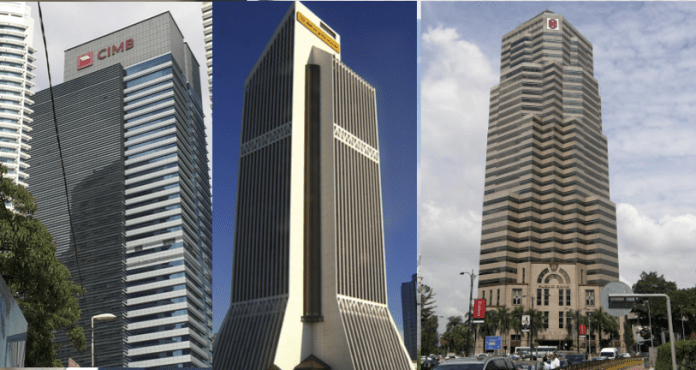
RHB Research has downgraded the Malaysian banking sector to NEUTRAL from OVERWEIGHT, citing emerging asset-quality risks, rising funding costs and diminishing sector catalysts despite resilient loan growth and healthy lending indicators.
The research house named AMMB Holdings Bhd, Malayan Banking Bhd and Hong Leong Bank Bhd as its top sector picks.
RHB said one of the key reasons for the downgrade was the gradual increase in gross impaired loans (GIL), while loan loss coverage (LLC) levels have declined considerably since the end of 2024.
According to the research house, sector and system LLC have fallen by 16 percentage points and 11 percentage points, respectively, since end-2024.
This could mean banks can no longer rely as heavily on benign credit costs as a lever to support bottom-line earnings.
Funding costs are another emerging concern.
RHB said higher wholesale deposit rates are pushing banks back into competition for retail deposits. Strong loan pipelines and elevated loan-to-deposit ratios (LDRs) could intensify that competition and place additional pressure on funding costs.
At the same time, the sector’s capital-management story is now well flagged and, with the exception of AMMB, largely reflected in valuations, reducing the strength of another major catalyst for banking stocks.
Despite the more cautious sector view, Malaysia’s banking system continues to record healthy credit expansion.
Citing Bank Negara Malaysia’s July 2026 banking statistics, RHB said system loans grew 5.6% year-on-year, slightly faster than the 5.5% recorded in June and 5.4% in July 2025.
Non-household loans led growth, expanding 6.4% year-on-year, supported by a 20.5% increase in lending to the electricity, gas and water segment and a 16.3% rise in transport and communications.
Household loan growth remained steady at 5.0% year-on-year.
Within the household segment, loans for the purchase of securities increased 8.1%, while residential mortgages grew 5.4% and hire-purchase financing expanded 5.1%.
RHB maintained its forecast for system loan growth of between 5.0% and 5.5% for 2026.
Forward-looking lending indicators were also encouraging, particularly among businesses.
System loan applications increased 3.1% month-on-month and 12.8% year-on-year in July.
Non-household applications rose 5.0% from June and 23.5% from a year earlier, while household applications increased at a more moderate 1.4% month-on-month and 3.9% year-on-year.
Loan approvals were similarly robust, climbing 6.6% month-on-month and 15.8% year-on-year.
Non-household approvals surged 12.2% from the previous month and 29.7% year-on-year, more than offsetting a 0.8% month-on-month and 0.3% year-on-year decline in household approvals.
RHB said the strong non-household loan pipeline was consistent with feedback provided by banks during their recent results briefings.
Deposit growth, however, showed some moderation.
System deposits expanded 5.6% year-on-year in July, slowing from 6.0% in June, while the current account savings account (CASA) ratio slipped to 32.1% from 32.3%.
The system LDR stood at 88.8%, compared with 88.3% in June and the same 88.8% level recorded in July last year.
Meanwhile, the banking system’s liquidity coverage ratio eased to 148.7% from 149.7% in June and 158.4% a year earlier, although it remained comfortably above the regulatory minimum of 100%.
For RHB, the combination of healthy loan demand, elevated LDRs and higher wholesale funding rates means competition for deposits could become more pronounced, potentially creating pressure on banks’ funding costs and margins.
Asset quality remains broadly stable at the system level, but RHB highlighted signs that warrant closer attention.
System GIL was largely unchanged month-on-month, rising just 0.2%, but increased 4.8% from a year earlier in July.
The system GIL ratio remained unchanged from June at 1.43%, compared with 1.44% in July 2025.
The deterioration was concentrated in several sectors.
Impaired loans in transport and communications jumped 38.3% year-on-year, although they declined 0.8% month-on-month. Primary agriculture GIL increased 37.8% year-on-year but fell 0.4% from June.
Household GIL was also 8.8% higher from a year earlier while easing 0.2% month-on-month.
Conversely, mining and quarrying recorded a 37.8% year-on-year reduction in impaired loans, while electricity, gas and water saw a 26.3% improvement.
System LLC edged up to 81.5% in July from 81.3% in June but remained substantially below the 89.8% recorded a year earlier.
Despite RHB’s more cautious outlook, Malaysian banks continue to maintain strong capital buffers.
The system’s Common Equity Tier 1 ratio improved to 14.6% in July from 13.9% in June, while the total capital ratio remained at 18.2%.
RHB’s downgrade therefore reflects less concern about the banking system’s underlying resilience than a changing risk-reward proposition for banking stocks.
With asset-quality indicators beginning to warrant greater attention, funding competition increasing and previously supportive capital-management catalysts becoming increasingly priced in, the research house sees less justification for maintaining an overweight sector position.
It nevertheless continues to favour AMMB, Maybank and Hong Leong Bank as its preferred banking exposures.


