


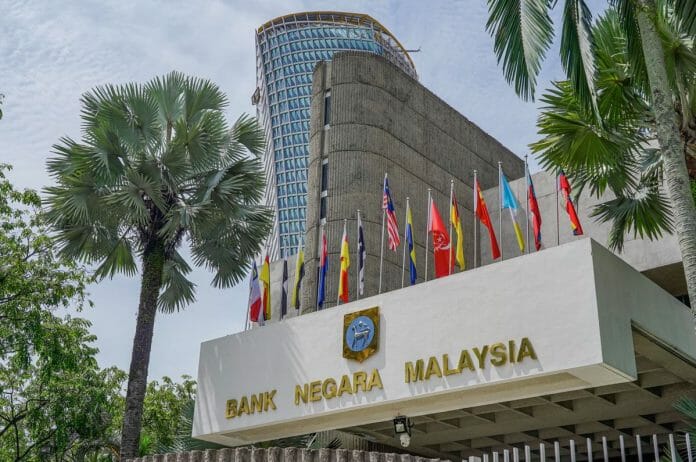
While yesterday’s announcement by Bank Negara Malaysia (BNM) is to keep the Overnight Policy Rate (OPR) unchanged at 2.75% for September, will the Central Bank maintain its stance for the rest of the year?
Kenanga Research believes BNM will stay hold for the remainder of 2026, noting that stronger economic growth and still-manageable inflation providing little urgency for further monetary policy adjustment.
The research house maintained its interest rate outlook after BNM’s Monetary Policy Committee (MPC) kept the OPR unchanged at its September meeting, in line with Kenanga’s expectations and market consensus.
Kenanga said the latest policy statement reinforced its assessment that the central bank remained “comfortably on hold”, particularly as BNM has turned more optimistic about Malaysia’s economic growth prospects.
The MPC maintained that the current monetary policy stance was “consistent with the outlook of continued price stability and sustainable economic growth”, while reiterating that it would remain vigilant to developments and assess the balance of risks surrounding domestic inflation and growth.
Kenanga said the language confirmed BNM’s continued data-dependent approach to monetary policy.
Of particular significance was BNM’s upgraded assessment of Malaysia’s economic outlook, with the central bank now expecting 2026 growth of around 5.0%.
This is more optimistic than its previous guidance that growth would be “firmly within” the 4.0% to 5.0% range, according to Kenanga.
The research house said the revision signalled greater confidence in Malaysia’s growth momentum and was also above the Ministry of Finance’s forecast of 4.0% to 4.5%.
Kenanga itself is even more bullish, forecasting Malaysia’s economy to expand 5.3% in 2026, compared with growth of 5.2% in 2025.
Its forecast follows stronger-than-expected economic performance during the first half of the year, underpinned by resilient domestic demand and net exports.
For 2027, BNM expects economic growth to remain resilient, supported by electrical and electronics (E&E) exports, continued strength in technology-related non-E&E exports, sustained tourism expenditure, stable labour market conditions and ongoing investment activity.
Globally, the MPC also adopted a more constructive assessment, with economic activity supported by strong technology-sector expansion, improving supply conditions and stable labour markets.
Kenanga noted that sustained technology-related expenditure was helping cushion economies against uncertainties arising from geopolitical developments.
Despite stronger economic activity and elevated external costs, inflation has remained relatively contained.
Headline inflation averaged 1.8% during the first seven months of 2026, while core inflation averaged 2.0%.
Kenanga said BNM observed that higher costs had so far seen limited pass-through to consumer prices, helped by domestic policy measures, stable demand conditions and limited spillover from export-led economic growth into wages.
Malaysia’s headline inflation stood at 1.8% in July, which Kenanga said remained well below levels that would warrant monetary policy tightening.
“With growth now assessed at around 5.0% in 2026 and inflation well below levels that would warrant tightening, there is limited urgency for further policy adjustment,” Kenanga said.
It expects the 2.75% OPR to continue striking a balance between firmer economic growth and emerging external cost pressures.
Nevertheless, external risks remain, particularly from geopolitical tensions in the Middle East.
BNM flagged elevated global commodity prices arising from the conflict as a potential upside risk to domestic costs.
MPC continued to see the overall balance of risks as broadly balanced. Downside risks to the global outlook include prolonged geopolitical tensions, tighter global financial conditions and elevated financial market valuations.
Domestically, a prolonged Middle East conflict and weaker commodity production could weigh on Malaysia’s growth performance.
On the upside, the economy could benefit from stronger-than-expected technology-related export demand, better global growth, higher tourism activity, a faster recovery in global supply chains and pro-growth policies in major economies.
Notably, Malaysia’s underlying growth fundamentals remain favourable, with support from both the external sector and resilient domestic demand.
Against that backdrop, the research house expects BNM to leave the OPR at 2.75% through end-2026, barring a significant deterioration in the growth outlook or a stronger-than-anticipated build-up in inflationary pressures.


