


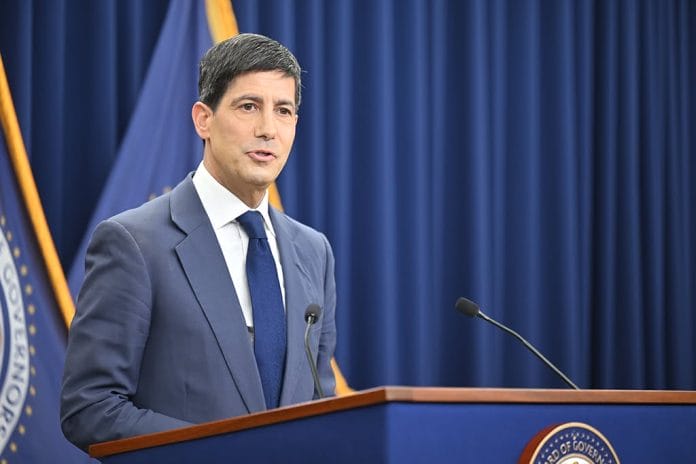
The likelihood of the US Federal Reserve raising interest rates this year has increased following Fed Chair Kevin Warsh’s latest remarks, although Standard Chartered believes there is little scope for a prolonged tightening cycle as inflationary pressures are expected to ease into next year.
Standard Chartered’s Rajat Bhattacharya and Sundeep Gantori said they see a slightly above 50% probability of a rate hike, potentially at the Fed’s Sept 16 meeting, provided upcoming US economic data remain sufficiently resilient.
In their latest market editorial, they said a September hike could become increasingly likely if August payrolls remain positive, unemployment stays around 4.1% and monthly core inflation comes in at 0.2% or higher.
“At Jackson Hole, Fed Chair Warsh opened the door to a potential rate hike, noting that rates are not restrictive, employment remains near full and underlying inflation is still elevated,” they said.
Under those conditions, Standard Chartered believes failing to raise rates could risk triggering another sell-off at the longer end of the US Treasury market while potentially undermining the Fed chair’s credibility.
However, the market impact of a hike could be relatively contained, given that money markets are already pricing in a greater than 50% probability of a September increase.
Weak Jobs Or Inflation Data Could Delay Hike
The alternative scenario would see the Fed hold rates if August payrolls contract for another month or if core inflation slows below 0.2% month-on-month.
Such data could strengthen the case of neutral-to-dovish policymakers opposing an immediate increase, with December then becoming the next likely opportunity for the Fed to reassess its position.
Standard Chartered considers an October hike unlikely because it would come just weeks before the US mid-term elections in November.
Even if the Fed proceeds with what the bank describes as a “defensive” rate hike this year, Bhattacharya and Gantori see limited scope for multiple increases.
They expect US inflation to move closer towards the Fed’s 2% target next year as the effects of tariffs and elevated oil prices diminish.
The reluctance of New York Fed President John Williams and Governor Christopher Waller to pre-commit to either a September or subsequent rate hike also supports the bank’s expectation that disinflation will eventually reassert itself.
Multiple rate increases could additionally prove counterproductive by pushing up already elevated US government borrowing costs, particularly as the Treasury shortens the maturity profile of its debt issuance, Standard Chartered said.
Bank Extends Preferred Bond Maturities
Against this backdrop, the bank views the recent increase in short- to medium-term bond yields as an opportunity for investors to gradually extend duration.
Standard Chartered has widened its preferred bond maturity range to three to seven years from three to five years, reflecting its expectation of further disinflation and limited upside to policy rates.
It continues to favour corporate bonds and said it is comfortable moving down to BB-rated US dollar-denominated credit, where yields of around 6.5% to 7.5% are available.
‘Buy On Dips’ Strategy For Equities
For equities, Standard Chartered advocates buying into weakness should rising bond yields, the historically softer September period or volatility ahead of the US mid-term elections pressure markets.
The bank said the fundamental earnings outlook remains supportive, with S&P 500 earnings per share growth of more than 20% expected in both the third and fourth quarters.
Historical performance also supports using September weakness to build longer-term equity positions, according to the editorial.
Over the past 15 years, buying the S&P 500 at its September low generated an average return of 11.4% over the following six months. In years when September itself ended in negative territory, the subsequent six-month average return increased to 15.1%.
The strategists said equities have historically been able to withstand higher bond yields as long as bond-market volatility remains contained and economic growth stays resilient.
ECB Seen Raising Rates By 25 Basis Points
While the next Fed decision remains finely balanced, Standard Chartered expects the European Central Bank (ECB) to raise rates by 25 basis points to 2.5% next week.
Euro-area GDP expanded by a stronger-than-trend 0.4% quarter-on-quarter in the second quarter, suggesting the region has weathered the energy shock better than initially feared, with momentum carrying into the third quarter.
Headline inflation climbed to a near three-year high of 3.3% year-on-year in August, driven by energy prices, although core inflation eased to 2.4%, suggesting limited second-round inflationary effects so far.
With little progress towards resolving the Middle East conflict, Standard Chartered said the argument for further pre-emptive ECB action has strengthened.
Attention will therefore turn to whether ECB President Christine Lagarde pushes back against market expectations for additional rate increases beyond the anticipated 25-basis-point move.


