


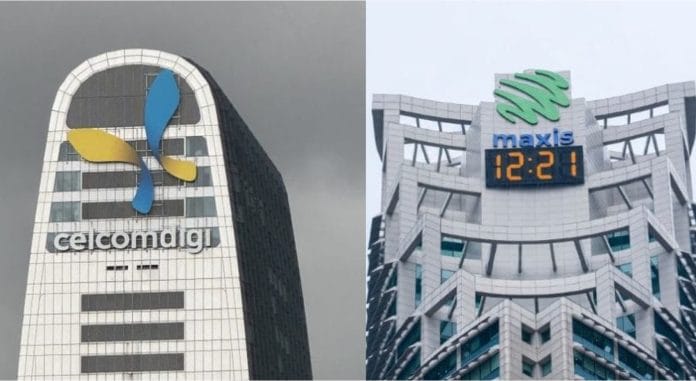
As Malaysia progresses on its implementation of the 5G Dual Network (5GDN) policy, a key near- term milestone is the equity accounting of DNB’s financials by its mobile network operator (MNO) shareholders in 4QFY26. The key questions for investors, therefore, is whether risks on DNB’s financial and operational trajectory and potential shareholder funding requirements are already reflected in current valuations. These risks are material, given their potential implications for the MNOs’ earnings and dividend outlook.
According to Kenanga Research, regulatory risks surrounding Malaysia’s 5G dual-network rollout are largely reflected in CelcomDigi Bhd’s depressed valuation, making the stock its preferred mobile network operator (MNO) play over Maxis Bhd.
In a telecommunications thematic report, Kenanga maintained a NEUTRAL view on the sector but kept an OUTPERFORM call on CelcomDigi with an unchanged target price of RM3.28, while retaining MARKET PERFORM on Maxis with a target price of RM3.70.
The research house said the next major milestone for Malaysia’s 5G Dual Network policy will be the privatisation of Digital Nasional Bhd (DNB) and the commencement of equity accounting for its financial results by its MNO shareholders, expected in 4QFY26.
CelcomDigi, Maxis and YTL Power International each hold a 33.3% stake in DNB, with the accounting change expected to provide greater clarity over the impact of DNB on shareholder earnings.
Kenanga said CelcomDigi currently trades at around two standard deviations below its historical valuation mean, providing greater downside protection.
Under its scenario analysis, the research house sees 37% potential upside and 26% downside for CelcomDigi, compared with about 21% upside and 20% downside for Maxis.
At a reference price of RM2.72, CelcomDigi trades at about 21.3 times FY27 forecast earnings, versus its historical average of 26.2 times.
Under Kenanga’s bull case, an improvement in DNB’s financial performance and a return towards CelcomDigi’s historical mean valuation could imply a fair value of RM3.72. A severe bear case could push the implied value to around RM2.02.
Maxis, by comparison, was trading at RM3.54 and about 18.1 times FY27 forecast earnings, relatively close to its historical average of 19.7 times, leaving less valuation cushion if earnings disappoint or DNB’s losses prove larger than expected.
Kenanga said Maxis’ comparatively resilient share price has been supported by stronger quarterly earnings, while CelcomDigi’s weaker post-merger earnings delivery has contributed to its deeper valuation discount.
A key potential catalyst for CelcomDigi is the faster-than-expected delivery of post-merger synergies.
Kenanga said CelcomDigi is targeting steady-state cost savings of about RM800 million annually, which could lift earnings before interest and tax margins by around five to six percentage points from pre-merger levels.
The research house said these savings are not yet fully reflected in its forecasts or market consensus, creating room for earnings upgrades if execution improves.
Kenanga nevertheless cautioned that DNB’s financial performance remains an important risk.
Its base case assumes DNB’s net loss narrows from RM1.21 billion in FY2024 to RM750 million, before declining further to RM500 million in FY2027.
The research house estimates DNB-related losses could have an approximately 8% earnings impact on both CelcomDigi and Maxis in FY2027.
DNB’s restructuring, manpower rationalisation, supplier contract renegotiations and potential network-sharing arrangements could help narrow losses over time, Kenanga said.
Each DNB MNO shareholder has so far committed approximately RM880 million to the 5G network company, excluding the nominal cost of acquiring U Mobile’s former stake.
This comprises RM552 million in cumulative shareholder advances and RM327.9 million committed for the acquisition of the Ministry of Finance Incorporated’s DNB stake, including the assumption of residual shareholder loans and accrued interest.
Kenanga said visibility remains limited over whether DNB will require further shareholder funding before achieving sustainable cash-flow breakeven.
However, it believes both CelcomDigi and Maxis have sufficient balance-sheet capacity to absorb a limited number of additional capital calls without materially compromising their financial positions or dividends.
For CelcomDigi, an additional RM200 million to RM500 million funding requirement in FY2027 would raise net debt-to-EBITDA only modestly to between 2.17 and 2.22 times, still below its internal ceiling of 2.5 times.
For Maxis, the same funding scenarios would lift gearing to between 1.75 and 1.82 times, leaving substantial debt headroom.
Kenanga said the bigger concern would be if DNB shareholder funding becomes a long-term recurring commitment because of a prolonged delay in reaching sustainable cash-flow breakeven.
Overall, the research house remains more constructive on CelcomDigi, arguing that its depressed valuation, potential post-merger synergies and more favourable upside-to-downside profile offer greater scope for a re-rating than Maxis.


