



Global hospitality groups are expanding their residential footprint across Asia Pacific, where 187 additional branded residence projects are expected by 2032, driving forecast market growth of 97% as operators push beyond the traditional luxury segment.
According to Savills, Wyndham is among the most aggressive movers, with 15 projects in the pipeline on top of one completed development, while Radisson has 13 planned projects alongside one existing scheme.
“Accor is also growing its regional pipeline, while Banyan Group remains a major player through its portfolio of hospitality and lifestyle brands.
“The market is becoming increasingly diversified, with luxury projects accounting for 48% of the regional pipeline and upscale developments making up 23%. Upper-upscale and selected midscale brands are also taking a larger share of future projects,” Savills Vietnam Managing Director Neil MacGregor shared.
He highlighted that the shift is allowing hotel operators to target a wider range of buyers and price points rather than relying solely on high-end luxury positioning.
“The expansion is creating opportunities for more hospitality operators, but developers are increasingly looking beyond international brand recognition when selecting partners.
“Service standards, operational capability and alignment with a project’s target buyers and long-term positioning are becoming equally important,” he said.
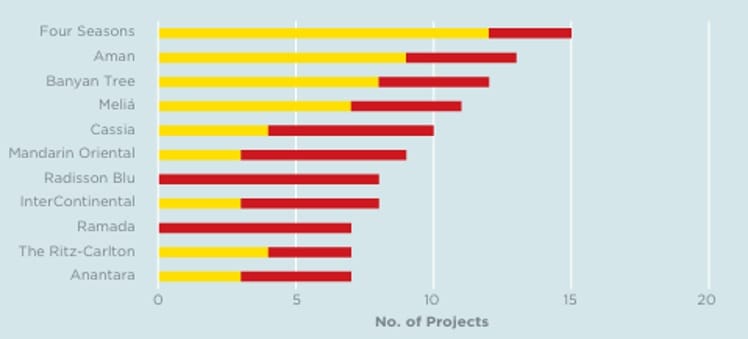
On the other hand, he also shared that Asian hospitality groups are also maintaining a strong presence, with five of the region’s 10 leading hotel brands originating from Asia Pacific.
“Regional operators could benefit from their familiarity with local buyers and established customer relationships,” he said.
Meanwhile, integrated hotel-residential developments are gaining traction. Resort projects account for 65% of the future pipeline, compared with 50% of completed developments, while standalone projects have fallen to 16% of the pipeline from 30% of completed schemes.
The average branded residential premium in Asia Pacific has also risen to 29% from 23% over the past year, compared with the global average of 33%.
He said future competition will increasingly depend on operators’ ability to deliver consistent service, meet local buyer expectations and maintain residential quality over time.


