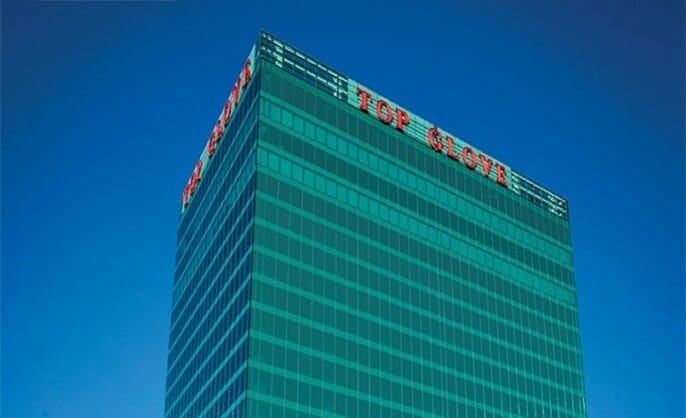
Top Glove announced a solid financial year earnings yesterday, prompting Kenanga Research to raise its target price to 82 sen from 71 sen after the glove maker’s FY2026 core net profit significantly exceeded expectations, however the house has maintained its MARKET PERFORM call amid concerns over oversupply and rising operating costs.
Top Glove’s FY2026 core net profit surged five-fold to RM308 million, coming in 54% above Kenanga’s forecast and 30% ahead of consensus estimates.
The earnings beat was largely driven by stronger-than-expected margins following a sharp increase in average selling prices (ASPs) during the second half of FY2026.
Kenanga, however, cautioned that the group’s 4QFY26 EBITDA margin of 17%, the highest since FY2019, is unlikely to be sustainable.
The research house said Top Glove continues to face a challenging operating environment marked by persistent industry oversupply, potentially higher minimum wages and an expected increase in natural gas tariffs.
Quarter-on-quarter, Top Glove’s 4QFY26 revenue rose 14% as a 19% increase in ASPs more than offset a 7% decline in sales volume.
Core profit nearly doubled to RM157 million, also supported by a positive tax write-back arising from previously unutilised tax losses.
For the full year, revenue increased 21%, driven by a 28% rise in sales volume, while EBITDA margin improved to 15% from 11% in FY2025.
The company declared a final dividend of 1.5 sen per share.
Plant utilisation fell to 71% in 4QFY26 from 81% in the previous quarter, contributing to the decline in sales volume.
However, management expects volumes to improve in 1QFY27 after customers accelerated purchases in September ahead of anticipated price increases in October and November.
Kenanga said nitrile raw material costs climbed from about US$950 per tonne in August to US$1,100 in September, reflecting higher crude oil prices and Middle East supply disruptions.
Top Glove expects nitrile glove ASPs to rise by US$2-US$3 per 1,000 pieces, from about US$20 to US$22-US$23.
Kenanga estimates that a RM100 monthly increase in the minimum wage could reduce Top Glove’s bottom-line profit by around 5% if the additional cost cannot be passed on to customers.
Labour accounts for about 9% of production costs.
The research house said an ASP increase of roughly US$0.20 per 1,000 pieces would be sufficient to offset every RM100 increase in monthly minimum wages.
Natural gas tariffs, meanwhile, could rise by 20%-30% towards the end of 2026, according to management guidance.
As gas represents around 10% of production costs, Kenanga estimates a 30% tariff increase could reduce earnings by 2%-3% without cost pass-through. An ASP increase of about 1% would be needed to offset the impact.
Kenanga increased its FY2027 net profit forecast by 50%, mainly after raising its ASP assumption to US$23 per 1,000 pieces from US$20.
Its revised 82 sen target price is based on 22 times FY2027 forecast earnings, below Top Glove’s historical one-year forward average price-to-earnings multiple of 24 times.
Key downside risks include aggressive pricing by Chinese glove manufacturers, weaker-than-expected demand growth and unfavourable tariff changes affecting Malaysian glove producers.