Home Blog Page 2668

The Imperative of International Industrial Research and Technology Universities

0

In an era defined by rapid technological advancements and the relentless pursuit of innovation, the role of universities transcends traditional academic boundaries. With its sights set on becoming a global technological powerhouse, Malaysia is strategically positioning itself to transform its universities into International Industrial Research and Technology hubs. This article explores the critical importance of this transition, comparing it to the current international research university model. We will delve into why universities worldwide are embracing the 1-on-1 scale approach, investing in industry-aligned lab facilities, and steering towards IR 5.0 to align with the vision for 2030.

Pursuing international industrial research and technology university status is synonymous with Malaysia’s ambition to be at the forefront of global technological innovation. As the world advances into the Fifth Industrial Revolution (IR 5.0), characterized by integrating cyber-physical systems and artificial intelligence into various industries, universities must evolve to meet future demands.

Malaysia’s 2030 vision recognizes the pivotal role of technology in driving economic growth and enhancing the country’s competitiveness. The transition to an international industrial research and technology university model signifies a commitment to nurturing a talent pool capable of leading in emerging fields such as quantum computing, biotechnology, and sustainable energy.

The current international research university model has successfully produced groundbreaking research. Still, the transition towards an industrial research and technology focus signifies a more profound commitment to bridging the gap between academia and industry. The 1-on-1 scale approach and industry-aligned lab facilities create an environment where theoretical knowledge seamlessly integrates with practical application.

Evidence from leading universities globally showcases the benefits of this approach. For example, the Massachusetts Institute of Technology (MIT) in the United States, renowned for its emphasis on hands-on learning and collaboration with industries, consistently produces graduates who significantly contribute to technological advancements and economic development.

The evolution towards Industry 4.0 has reshaped the nature of laboratories within universities. The emphasis on 1-on-1 scale products and industry-aligned lab facilities reflects the need for students to engage with technologies mirroring those found in the real-world industrial setting.

Universities worldwide are investing in advanced laboratories equipped with cutting-edge technologies, enabling students to work on projects that simulate industry challenges. This prepares them with technical skills and the ability to navigate the complexities of modern workplaces. Malaysia’s commitment to Industry 4.0 aligns with the government’s initiatives to drive digital transformation and innovation.

The journey towards IR 5.0 is a proactive step to prepare students for future technologies. The 2030 vision for Malaysia recognizes the need to embrace technologies such as artificial intelligence, blockchain, and the Internet of Things. International Industrial Research and Technology Universities are positioned to lead in these domains, fostering an environment where students engage with and contribute to developing IR 5.0 technologies.

A report by the World Economic Forum highlights that future jobs will require a combination of technical and social skills. The transition to IR 5.0 necessitates universities to go beyond traditional academic boundaries and instill in students the ability to adapt to rapidly changing technological landscapes.

The international status of industrial research and technology universities opens doors to global collaboration and knowledge exchange. Collaborative research projects with international partners and industry players enhance the university’s reputation on the worldwide stage. This, in turn, attracts top-tier faculty and students, fostering a diverse and dynamic learning environment.

Leading international universities, such as ETH Zurich in Switzerland and the Technical University of Munich in Germany, have established themselves as hubs for global collaboration. Malaysia’s shift towards international industrial research and technology universities positions the country as a critical player in the worldwide knowledge exchange network, attracting talent and investment.

The transition to an international industrial research and technology university model is not just an academic endeavor but a strategic move to drive economic growth and job creation. A study by the McKinsey Global Institute estimates that technological advancements, particularly those associated with Industry 4.0, could contribute trillions of dollars to the global economy.

The teaching is also changing into mentor and mentee interaction between trainer and trainee. Instead of tedious classroom interaction, which is still quite famous in Malaysia, the current IR 5.0 will see a change in academic teaching. All the learning will be a heads-on teaching experience, with 1-on-1 similar activities in industries and backgrounds. All the education will be based on hands-on, 1-on-1, identical to those practical in industry and not only based on books and theory-based learning in classrooms.

By aligning university curricula with industry needs, Malaysia aims to produce a workforce that can drive innovation, attract foreign investments, and propel the nation towards becoming a high-income economy. The emphasis on practical skills, real-world projects, and global collaboration positions graduates to be job-ready and capable contributors to economic development.

In conclusion, Malaysia’s pursuit of international industrial research and technology university status signifies a bold step towards global technological leadership. The transition from the current international research university model to one that emphasizes 1-on-1 scale products, industry-aligned lab facilities, and readiness for IR 5.0 is rooted in the recognition of the transformative power of technology on economies and societies.

As Malaysia charts its course towards the 2030 vision, the role of universities as catalysts for innovation, economic growth, and global collaboration becomes increasingly pivotal. The evidence presented in this article underscores the importance of this transition, positioning Malaysia on the international stage as a hub for technological excellence and a driver of the next wave of industrial revolution.

Ts. Dr. Hj. Muhammad Khusairy Bin Capt. Hj. Bakri is a Postdoctoral Research Associate at Composite Materials and Engineering Center, Washington State University (WSU), a Faculty-Staff member for the Center of Bioplastics and Biocomposites (CB2) for North Dakota State University, United States of America, and a Lead Research and Development Sector of the Association of Professional Technicians and Technologists (APTT) Sarawak, Listed and indexed in the “Science and Research” category on the Fifth Edition of “Successful People in Malaysia” by Britishpedia as a successful young researcher in Malaysia published by British Publishing House Ltd., working on composite materials from the forest and industry products.

Be Wary Of eMADANI Credit Scammers

0

The Ministry of Finance (MoF) has advised members of the public to be cautious of offers by irresponsible parties providing cash-out or peer-to peer transfers of eMADANI credit.

This is to prevent eMADANI beneficiaries from falling prey to scammers and consequently lose their eMADANI credit.

The MoF will not be responsible for any loss of eMADANI credit arising from peer-to-peer transfers or cash-out transactions.

Should there be any reports of cases involving peer-to-peer transfers and cash-outs, the Government will take stern action against the offenders by blocking their accounts and forfeiting the e-credit.

The eMADANI programme has the objectives of stimulating the economy and fostering a cashless culture. Therefore, the eMADANI credit cannot be used for certain transactions, which include peer-to-peer transfers and cash-outs. It may be used only for physical purchases via the participating e-wallets, namely MAE, Setel, ShopeePay, and Touch ‘n Go eWallet, or via DuitNow QR code, at 1.8 million retailers and businesses nationwide.

Registration for the eMADANI programme opens today until 20 February 2024, and will benefit 10 million eligible adult Malaysians, covering the B40 and M40 categories.

For more information on the eMADANI programme, visit https://manfaat.mof.gov.my/individu/eMADANI

Bursa Tipped To Extend Winning Streak

0

Bursa Malaysia market has moved higher in back-to-back sessions, collecting more than 10 points or 0.7 percent along the way.

The Kuala Lumpur Composite Index now sits just above the 1,455-point plateau and it may add to its winnings on Monday.

At 9.18am, the FBM KLCI opened at 1,455.51.

RHB Retail Research Market Dateline said today (Dec 4) said the FKLI jumped 14.50 pts during Friday’s session to close at 1,461 pts as the market sentiment improved during the first trading session of December. The index began Friday’s session at 1,452.50 pts.

After setting its foothold at the 1,449.50 pts day’s low, it climbed to the 1,462 pts day’s high and closed at 1,461 pts – printing a bullish candlestick.

The latest positive price action, coupled with the RSI rounding upwards, suggests the bullish momentum is picking up pace again.

The technical indicators show the index has completed the consolidation and is resuming its upward movement.

The bulls are setting its sights to test the 1,468.50-pt immediate resistance. In a bullish setup, it is likely the FKLI will break past the resistance.

On the downside, the 50-day SMA line continues trending higher – providing support for the bullish setup. As the bullish momentum is gaining strength now, RHB make no change to the positive bias.

Malacca Securities (MSSB) said the FBM KLCI (+0.25%) closed higher from last minute buying activities in Telco counters AXIATA (+7.0 sen) & MAXIS (+6.0 sen).

On the broader market, the Healthcare sector (+1.60%) rose carried by glove counters, while the Energy sector (-1.63%) fell amid the weaker oil prices.

Global markets: Wall Street ended higher as the Fed Chair’s comments and the weaker manufacturing data further cemented expectations of the end to rate hikes.

Meanwhile, the European stock market ended higher, while Asia ended lower despite the increase in Chinese Caixin manufacturing PMI data.

The Day Ahead

Following the bullish engulfing last week on the FBM KLCI, the buying support continued within selected Telecommunication heavyweights; lifted the KLCI higher for the second session.

Meanwhile, with the Fed’s Chair Jerome Powell offered optimism on the progress that the US central bank’s 2% inflation target is well on track, the Dow & S&P500 surged to highest close in 2023, with the market looking at a peak of interest rate and looking for rate cut potential in 2024.

This week, MSSB expects traders to focus on the (i) ISM Services PMI, (ii) jobs data such as unemployment claims, unemployment rate, non-farm payroll.

On the commodity markets, the Brent oil prices traded below USD80/bbl with as traders were not convinced by the additional voluntary cuts from OPEC+ members, while the gold price surged towards all-time-high at on the back of rate cut optimism.

Sector focus: MSSB expects the investors to re-assess and trade the companies with positive growth in earnings following the November reporting season.

MSSB favours the Poultry sector, specifically the egg segment as traders could be waiting for the upliftment of egg’s ceiling price. Also, in view of the strong gold price, the gold retailing stocks could be favourable to trade.

Meanwhile, with the Brent oil prices declining, traders may be avoiding in the near term.

Oil Gains With US Interest Rates, Venezuelan Supply In Focus

0

Oil advanced after a six-week run of losses on speculation that the Federal Reserve is done raising interest rates and the possibility that US sanctions on Venezuelan supply could be tightened up once again.

Benchmark Brent rose toward $80 a barrel after capping the worst run of weekly declines in two years, while West Texas Intermediate neared $75. Investor expectations the Fed’s next move will be a cut has gathered strength this quarter, hurting the US dollar to make commodities more attractive.

Venezuelan supply was also in focus after the White House said it was evaluating possible consequences after President Nicolás Maduro missed an end-November deadline to release detained Americans. The US struck a deal with Venezuela in October to lift some sanctions, including on oil, and there’s concern the six-month transaction license may not be renewed.

Oil just capped a back-to-back monthly decline as supplies from non-OPEC countries including the US ballooned, while the outlook for demand growth softened, Bloomberg reported.

The retreat came despite a move last week by the Organization of Petroleum Exporting Countries and its allies to deepen production cuts.

In the Middle East, meanwhile, Iranian-backed Houthi rebels claimed they targeted two Israeli ships in the Red Sea, part of a series of attacks against commercial vessels in international waters amid the war in Gaza. The US said one of its destroyers shot down three drones.

TNG Users Can Claim Their RM100 eMADANI Credit From Dec 4

TNG Digital Sdn. Bhd. announced that they will be giving out up to RM100 million worth of GOrewards points and free merchant vouchers for each successful eMADANI 2023 claimant. eMADANI 2023, is an initiative by the Ministry of Finance (MOF) to nurture cashless spending and stimulate the economy for retail merchants and SME businesses.

Individuals who successfully claim their eMADANI credit with Touch ‘n Go eWallet by TNG Digital will receive not only free merchant vouchers worth more than RM500 from over 60 renowned brands such as 7-Eleven, Watsons, Tealive, and more but also 1,000 GOrewards points. Points can then be redeemed for more attractive rewards that include strategic partner e-vouchers from renowned brands, Alipay+ Rewards, lucky draws, and physical products from Presto.

Malaysians aged 21 and above, with income below RM100,000 per annum, who are not a recipient of the past eBeliaRahmah credit are entitled to claim the RM100 eMADANI credit from 4 December 2023 to 20 February 2024. Successful claimants will receive extra rewards from Touch ‘n Go eWallet, including:

  • 1,000 GOrewards points
  • More than RM500 worth of vouchers, including online and retail, F&B, telco, transportation, and more
    The credit can only be used for in-store purchases and must be utilised by 29 February 2024, as per criteria set by MOF.
    To enjoy the best rewards by Touch ‘n Go eWallet, TNG Digital encourages all eligible Malaysians to make the smart choice by downloading the Touch ‘n Go eWallet and completing their account verification process if they have not done so.

Stock Picks Of The Day – AMMB, Dufu Technology

0

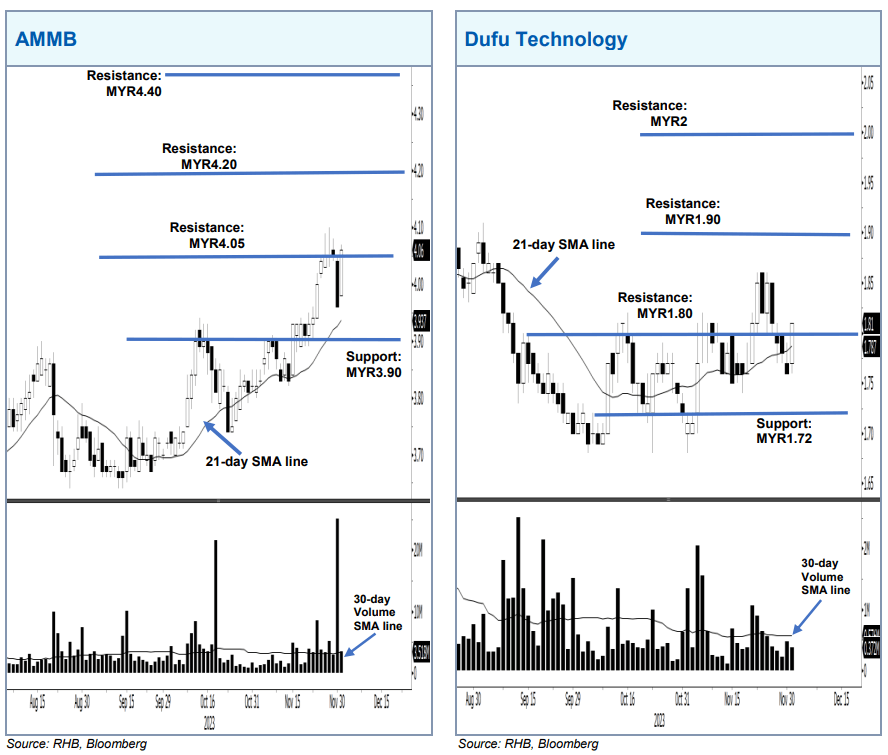
AMMB is poised to extend the positive price action after staging a bullish breakout during Friday’s session.

RHB Retail Research Market Dateline said today (Dec 4) said the stock has crossed above the MYR4.05 resistance with a “higher high” bullish candlestick.

The latest breakout suggests the momentum is picking up pace and may propel the stock towards the next resistance at MYR4.20, followed by MYR4.40.

On the other hand, falling below the MYR3.90 support will negate the bullish setup.

Dufu Technology is resuming the upside movement after breaking past the resistance with a bullish candlestick.

On Friday, the stock climbed above the MYR1.80 resistance and charted a long bullish candlestick.

The price action suggests the correction is over and the bulls are having the upper hand now. The renewed momentum should lift the stock towards MYR1.90, followed by the MYR2 mark.

On the other hand, falling below the MYR1.72 support will resume the bearish phase.

Hang Seng Index Futures: Hovering Below 17,000 Pts

0

The HSIF continued to see negative sentiment on Friday, with the index falling below the 17,000-pt support level to close at 16,895 pts.

RHB Retail Research Market Dateline said today (Dec 4) said it started at 17,051 pts and touched the high of 17,137 pts before declining for the rest of the session.

The index hit a low of 16,865 pts before closing in negative territory. In the evening, it recouped 47 pts and was last traded at 16,942 pts.

The negative price action showed that the bears have trumped the bulls, and are eyeing the next support level at 16,500 pts.

The RSI is also trending below the 50% threshold and pointing downwards, reflecting the pick-up in negative momentum.

While RHB do not discount the possibility of a counter-trend rebound, the immediate resistance at 17,600 pts will be tough to breach.

The 50-day and 20-day SMA lines are trending lower, adding downward pressure on the index.

As the stop-loss was breached, RHB shifts to a negative trading bias.

Singapore Bourse May Reclaim 3,100-Point Level

0

The Singapore stock market has moved higher in two of three trading days since the end of the four-day losing streak in which it had slumped almost 50 points or 1.6 percent. The Straits Times Index now sits just above the 3,090-point plateau and it may extend Friday’s gains.

The global forecast for the Asian marketsis positive on growing optimism over the outlook for interest rates. The European and U.S. markets were solidly higher and the Asian bourses are expected to open in similar fashion.

The STI finished modestly higher on Friday as gains from the financial shares and industrials were capped by weakness from the property sector.

For the day, the index gained 17.32 points or 0.56 percent to finish at 3,090.31 after trading between 3,077.41 and 3,094.15.

Among the actives, Ascendas REIT lost 0.35 percent, while CapitaLand Integrated Commercial Trust spiked 1.65 percent, CapitaLand Investment advanced 0.66 percent, City Developments retreated 1.28 percent, DBS Group rose 0.50 percent, Emperador slumped 0.96 percent, Genting Singapore added 0.55 percent, Hongkong Land dropped 0.93 percent, Keppel Corp soared 2.70 percent, Keppel DC REIT surged 4.35 percent, Mapletree Pan Asia Commercial Trust climbed 0.73 percent, Mapletree Industrial Trust shed 0.44 percent, Oversea-Chinese Banking Corporation rallied 0.80 percent, Seatrium Limited plunged 2.86 percent, SembCorp Industries jumped 1.17 percent, Singapore Technologies Engineering gained 0.54 percent, SingTel fell 0.43 percent, Wilmar International sank 0.55 percent, Yangzijiang Financial tumbled 1.56 percent and Yangzijiang Shipbuilding, Comfort DelGro, SATS, Thai Beverage and Mapletree Logistics Trust were unchanged.

The lead from Wall Street is upbeat as the major averages shook off early weakness on Friday, quickly moving firmly into the green and staying that way for the remainder of the session.

The Dow spiked 294.61 points or 0.82 percent to finish at 36,245.50, while the NASDAQ rallied 78.83 points or 0.55 percent to close at 14,305.03 and the S&P 500 added 26.83 points or 0.59 percent to end at 4,594.63.

For the week, the Dow surged 2.4 percent, the S&P 500 increased 0.8 percent and the NASDAQ rose 0.4 percent, RTT News reported.

The strength on Wall Street reflected ongoing optimism about the outlook for interest rates following a report from the Institute for Supply Management showing continued contraction in U.S. manufacturing activity last month.

Some analysts suggested that the weaker-than-expected ISM survey may spur expectations that the Fed’s next move is an interest rate cut.

Crude oil prices fell sharply on Friday, extending losses from the previous session amid mounting skepticism over OPEC output cuts. West Texas Intermediate Crude oil futures for January ended lower by $1.89 or 2.5 percent at $74.07 a barrel. Oil prices have now fallen in six straight weeks.

U.S. Stock Rally Could Wobble After Red Sea Attacks

0

An attack on an American warship and commercial vessels in the Red Sea on Sunday risks reigniting investor worries about a widening of the war between Israel and Hamas, potentially complicating the outlook for a rally that saw U.S. stocks crest a fresh closing high for the year last week.

The Pentagon said it was aware of reports regarding attacks on an American warship and commercial vessels in the Red Sea on Sunday, while Yemen’s Houthi group claimed drone and missile attacks on two Israeli vessels in the area.

Also on Sunday, a U.S. military official told Reuters the United States carried out a self-defense strike in Iraq against an “imminent threat” at a drone staging site.

The developments risk inflaming fears that the Israel-Hamas war could widen into a broader conflict encompassing the U.S. and regional players like Iran. Such worries flared after Hamas’ Oct. 7 attack into southern Israel but subsided in recent weeks.

Quincy Krosby, chief global strategist at LPL Financial, said a widening conflict could push some investors to take profits on the recent rally in stocks. The S&P 500 rose nearly 9% in November on signs of easing inflation and hopes the Federal Reserve is done raising interest rates. The index is up almost 20% on the year after notching a 2023 closing high on Friday at 4594.63.

“The market is sensitive to any expansion of this conflict,” she said. “I think active managers in any event are more likely to lock in their gains if this is a harbinger of a deeper military conflict that involves the US.”

Past spikes in geopolitical tensions have made investors head for popular havens such as gold, Treasuries and the U.S. dollar. Signs of an intensifying Middle East conflict could also boost oil prices, which have slumped in recent weeks, Reuters reported.

Phil Orlando, chief equity market strategist at Federated Hermes, said rising tensions in the region could send West Texas Intermediate crude prices up to between $80 and $90 per barrel. Prices on Friday stood at $74.07.

The developments come as investors eye factors that could sway stocks in coming weeks. A U.S. employment report due on Friday could bolster the case for those arguing that a cooling economy will keep the Fed from raising interest rates further and possibly loosen monetary policy sooner than expected.

Other potential catalysts include the Fed’s monetary policy meeting on Dec. 12-13, as well as seasonal factors such as tax-loss selling and the so-called Santa Claus rally.

Orlando said a spike in geopolitical tensions could drop the S&P 500 by “one or two hundred points.”

“There’s no question this represents an opportunity for investors to take profits,” he said. “However I’m still convinced the index ends the year at 4,600.”

From Vision to Greens: De Lettuce B.E.A.R’s Journey to Nutrient-Rich Agriculture

In the heart of Southeast Asia, a story of innovation, sustainability, and social responsibility is unfolding.

Meet Chin Jia Zhuang, the visionary CEO of De Lettuce B.E.A.R, a trailblazing company that is reshaping the landscape of lettuce farming and nutrition across Malaysia and Southeast Asia.

Chin’s journey started as a young professional, climbing the ranks from a Sales Executive to a Regional Manager at Tecumseh Euro Malaysia. With determination and grit, he managed to penetrate the Thailand market, turning zero sales into over USD 550k within just three years. Yet, it was his deeper passion for nutrition and business development that would lead him to his next chapter of life.

“I find the nutrition field fascinating because the right mix of nutrition can boost the health of animals and humans by leaps and bounds,” says Chin. “On the other hand, business development is a wonderful field as it enables all ideas, products, and solutions to reach the world while rewarding the entrepreneurs, scientists, and employees who make it happen.”

And so, De Lettuce B.E.A.R was born, not just as a business idea, but as a socially enriching vision. Recognising the demand for healthier, pesticide-free lettuce among Southeast Asian consumers, particularly the health-conscious Gen Z, Chin saw an opportunity to bridge the gap between nutritious produce and conscientious farming practices.

But it wasn’t just about lettuce. It was about revolutionising the way we think about agriculture, sustainability, and food security. Armed with a clear mission, De Lettuce B.E.A.R embarked on a journey to provide selenium bio-fortified lettuces that would address both dietary deficiencies and environmental concerns.

Selenium, a vital micronutrient, was the key to this mission. Chin recognised the widespread deficiency of selenium in the region, which can lead to a range of health problems. This deficiency, coupled with the demand for healthier and environmentally friendly produce, became the driving force behind De Lettuce B.E.A.R’s commitment to biofortification.

Through years of research and experimentation, De Lettuce B.E.A.R developed a unique indoor vertical farming and hydroponic system that not only increased lettuce yield and nutrition but also contributed to environmental sustainability. By leveraging artificial intelligence (AI) technology, the company achieved 40% higher yields, 50% richer nutrition, and zero use of pesticides and herbicides.

“The combination of lettuce-specific knowledge and AI expertise allows us to biofortify our lettuce with selenium, making it 10x richer than average lettuce,” explains Chin. “Our lettuce now caters for 50% of an individual’s daily selenium intake, addressing both dietary needs and environmental concerns.”

The journey didn’t stop there. Chin’s commitment to education and sustainability led him to establish a partnership with Kasetsart University Thailand, a respected institution that shared their values. This collaboration aimed to drive innovation, enhance the quality of agricultural products, and promote sustainable food systems for the future.

Looking ahead, De Lettuce B.E.A.R’s vision is expansive. With the ASEAN population’s increasing demand for vegetables and changing dietary habits, the company sees enormous potential for growth. Their lettuce, once a simple leafy green, has transformed into a symbol of innovation, health, and sustainability.

As Chin reflects on his journey, he emphasises the importance of viewing life in chapters. “Growing De Lettuce Bear into the leading lettuce producer across Malaysia and Southeast Asia is my biggest chapter yet,” he smiles. “It’s a collective vision, a project that involves everyone who takes part.”

With De Lettuce B.E.A.R leading the way, the future of agriculture is looking greener, more nutritious, and undoubtedly promising.

Improve your business capital today from RM3,000 – RM500,000. Approval within minutes, money received in minutes with Maybank SME Digital Financing. Learn more

China Confident In Coping Financial Risks And Challenges

0

China is confident, well-positioned and capable of coping with various financial risks and challenges, thanks to its sound long-term fundamentals providing a solid foundation, noted Li Yunze, head of the National Financial Regulatory Administration.

The strong resilience, huge potential, robust vitality and sound fundamentals of the country’s economy remain unchanged, providing the greatest confidence, guarantee and backstop for preventing and defusing financial risks, Li told Xinhua in an exclusive interview.

China’s financial sector has functioned smoothly and demonstrated an overall strong resilience against risks, Li said.

According to official data, the non-performing loan ratio of commercial banks stood at 1.61 percent by the end of the third quarter, while their provision coverage ratio, a measure of backstop against financial risks, came in at 207.89 percent, both within the reasonable range.

In the next step, efforts will focus on facilitating the reform and progress in de-risking for medium-sized and small financial institutions, according to Li.

In this regard, Li highlighted the importance of formulating targeted and precise measures such as making province-specific or bank-specific risk disposal plans.

Efforts are also needed to push forward structure optimization of the medium-sized and small banking institutions, as well as to guide asset management and non-banking institutions to stay in their lane and develop differentially, Li noted.

Former Health Minister Datuk Chua Jui Meng Passes Away

0

Former health minister Datuk Chua Jui Meng, 80, who was also once a member of the current government’s main party member died at the Serdang Hospital at 4pm today.

In a Facebook posting the party said “He was the Johor Keadilan chairman for five years from 2009 to 2014, under Chua’s leadership, for the first time Keadilan won the Batu Pahat parliamentary seat and the Bukit Batu state seat in the 2013 general election.”

Chua was the country’s longest serving health minister from 1995 to 2004 and a five-term MP for Bakri from 1986 and 2008.

He was an MCA vice-president before joining Keadilan.

Think Of What Happened To Hong Kong When You Vote, Taiwan President Says

0

Taiwan President Tsai Ing-wen appealed to voters on Sunday (Dec 3) to think of what had happened to Chinese-controlled Hong Kong when they cast their ballots next month, saying peace must be backed up with a commitment to boost defences.

Taiwan prepares for presidential and parliamentary elections on Jan 13 as China, which claims the island as its own territory, ramps up military pressure to assert its claims, including two major war games around the island in the past year and a half.

China and Taiwan’s main opposition party, the Kuomintang (KMT), have cast the election as a choice between war and peace. China detests Taiwan’s ruling Democratic Progressive Party (DPP) and its presidential candidate, Vice President Lai Ching-te, calling them dangerous separatists.

Addressing supporters at a campaign rally for Lai in the capital Taipei, Tsai said the opposition was using “alarmist talk” of war and peace.

“I want to ask you all here, does anyone want war? Nobody does,” she said. “Look at Hong Kong and think of Taiwan. We don’t want Hong Kong-style peace. We want dignified peace.”

Hong Kong, a former British colony, was returned to Chinese rule in 1997 with the promise of wide autonomy under a “one country, two systems” framework, which China has also offered to Taiwan – with little support on the island.

Beijing in 2020 imposed a tough national security law on Hong Kong, which it said was vital to restore stability after the city, a global financial hub, was rocked for months by sometimes violent anti-government and anti-China protests in 2019.

Tsai, barred by term limits from seeking re-election, has made bolstering Taiwan’s defences a cornerstone of her tenure, a stance that Lai, leading in the polls, has pledged to continue.

They say only Taiwan’s people can decide their future and have repeatedly offered talks with China but been rebuffed.

“To ensure peace we need to strengthen our ability to defend ourselves. Our house will have locks on it, but not to provoke our neighbours,” Tsai told the rally. “Only with determination can we defend dignity, and only with strength can we ensure peace.”

KMT presidential candidate Hou Yu-ih said on Saturday a vote for the DPP was equivalent to “sending everyone out to the battlefield” because supporting Taiwan independence would touch off a war.

The KMT traditionally favours close ties with China but strongly denies being pro-Beijing. It has pledged to reopen talks with China if it wins the election.

Reuters

BNM, World Bank To Enable Financial Sector Support Nature-Positive Outcomes

0

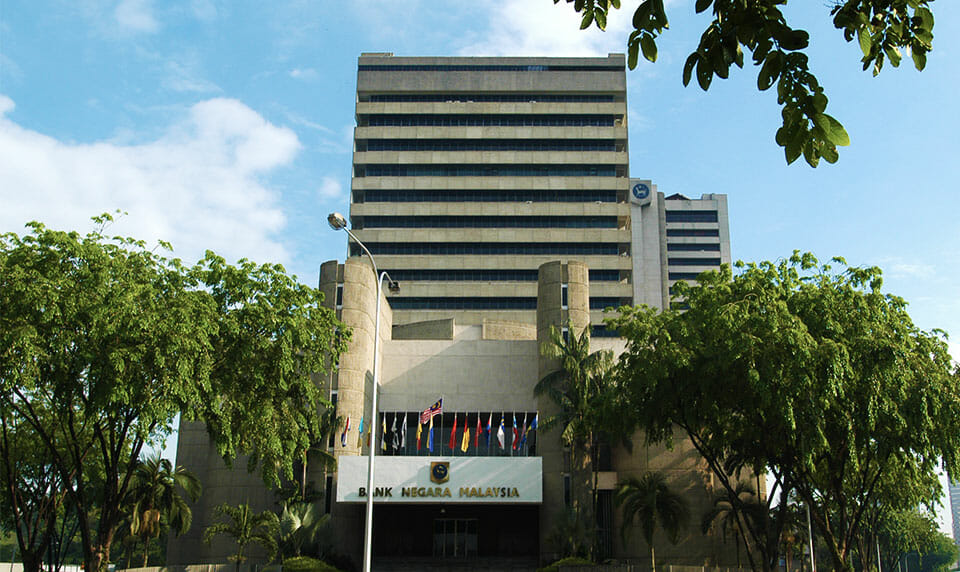
Bank Negara Malaysia and the World Bank have announced two key initiatives to enable the financial sector to support nature-positive outcomes which will facilitate the integration of nature-related considerations into decision-making while supporting financial flows towards nature-based solutions.

This follows from the recommendations outlined in the report ‘An Exploration of Nature-related Financial Risks in Malaysia’ released in 2022. Bank Negara Malaysia Governor Datuk Abdul Rasheed Ghaffour said, “The partnership announced today is in recognition of the implications of nature- related risks to a megadiverse country like Malaysia. The collaboration sealed today will bring about greater alignment between financial flows and positive outcomes.”

The World Bank Country Director for Brunei, Malaysia, Philippines and Thailand Ndiame Diop said, “With this collaboration, Malaysia aims to develop robust measures to increase finance for the natural world, thereby setting a good example for other nations grappling with nature-related financial and economic risks.”

A Nature-related financial risks assessment guide will be developed in consultation with the Taskforce on Nature-related Financial Disclosures (TNFD) Secretariat. The aim is to support Malaysian financial institutions and businesses in identifying and assessing an organisation’s nature-related dependencies, impacts, risks and opportunities. The guide will be based on the integrated approach that TNFD has developed for the identification and assessment of nature-related issues, called the LEAP2 approach.

This will also make BNM a member of the TNFD Forum, a global multidisciplinary consultative group that is aligned with TNFD’s mission and principles.

BNM and the World Bank will then facilitate the development of innovative financial instruments to support private investments in nature. This includes enabling regulations to support nature-positive outcomes and piloting new financial structures.

COP28: Maybank Launches Malaysia’s First Transition Finance Framework

0

Banking giant, Maybank has launched its Transition Finance Framework, the first by a Malaysian bank at COP28 Dubai, which is the funding of greening of brown, emission-intensive sectors or asset.

The bank notes that it is critical to achieve a significant reduction in emission and it is apparent that no country, sector
or company is able to achieve Net Zero and climate goals with green finance alone. The primary objective of the Transition Finance Framework is to outline the Bank’s approach to the classification and recognition of financing solutions offered as credible transition finance, whilst the secondary objective is to guide the development of credible transition finance solutions within the Group based on internationally accepted guidelines and principles.

Dato’ Khairussaleh Ramli, Group President & CEO, Maybank said “The Maybank Group Transition Finance Framework’s principled-pragmatic approach allows Maybank to demonstrate the Group’s authenticity of supporting if not bolstering net zero economies in this era of global boiling.”

“We recognise that the transition finance space is still nascent in the ASEAN region and we are committed to contribute towards building and reinforcing a credible, orderly and just transition plan, which is underpinned by our Humanising Financial Services mission.”

While NRECC Minister Nik Nazmi said, I’m delighted that the framework provides the funding for selected brown sectors with credible transition pathways and or solutions such as hydrogen, bio energy as well as carbon capture, utilization and storage.”

Aligned to more than 12 international principles, standards and guidelines, the Maybank Group Transition Finance Framework complements the Maybank Group Sustainable Product Framework, which was a first developed by a Malaysian bank and launched in August 2022.

Covid-19 Cases Rises 57% To 3,626

0

Ministry of Health has noted a rise in Covid-19 cases with a total of 3,626 cases reported during the 47th epidemiology week from November 19 to 25, a significant increase of 57.3 per cent compared to the 2,305 cases recorded from the previous week.

Health director-general Datuk Dr Muhammad Radzi Abu Hassan said 48 percent of the cases involved those between the ages of 20 and 40, with more than 98 per cent of them only having mild symptoms.

He said the weekly Covid-19 cases had exceeded 1,000 cases every week from Week ME 41/2023 to ME 47/2023 with an increased rate of between 7.1 to 57.3 per cent.

“The cumulative number of clusters reported up to ME 47/2023 is 7,248. The majority of clusters reported are education clusters,” he said in a statement today.

Dr Radzi said the admission rate of Covid-19 patients increased to 2.9 per 100,000 population compared to the previous week. 

The occupancy of intensive care unit (ICU) beds is currently at 0.4 per cent, non-critical Covid-19 beds at 0.9 per cent, while Covid-19 patients requiring ventilators remained at 0.2 per cent.

Although there is an increase in Covid-19 cases, he said, the situation is under control and does not burden existing health facilities.

According to him, a total of four new Omicron variants were reported all of which consisted of variant of concern (VOC).

He said the cumulative number of cases infected with the SARS-CoV-2 virus categorised as VOC and variant of interest (VOI) was 28,102, with 27,297 cases being VOC and 805 VOI cases.

Dr Radzi said two cases of the new Omicron variant BA.2.86 had been reported in Malaysia with both cases being treated as outpatients and in a stable condition.

The World Health Organisation recently reported an increase in the BA.2.86 variant, with the first reported on July 24 and classified as VOI.

UEM Edgenta Sees 60% Stake In Tech-Enabled Property Management Services Firm In UAE

0

UEM Edgenta Berhad (UEM Edgenta), a leading provider of Asset Management and Infrastructure Solutions across the region, proudly announces its strategic  partnership of a 60% stake in KAIZEN Group at the Conference of the Parties of the UNFCCC (COP28)  in Dubai.

KAIZEN Group is a tech-enabled property management services company headquartered in the  UAE. 

With a remarkable 16-year track record, KAIZEN Group is a pioneer in tech-driven end-to-end property  management services in Dubai. The group’s comprehensive offerings span across the real estate services  value chain, from Handover Services, Property Management, Investment Advisory, Lease Management  to Owners Association management.

It currently manages a portfolio of over 130 projects for some of the  notable real-estate landlords and developers in the UAE.

Notably, KAIZEN Group clinched awards in various categories including ‘Property Management Company  of the Year,’ ‘Sustainable Community Award,’ and ‘Partnership Award-PropTech’ at Smart Built  Environment 2023, alongside the ‘Happiest Residential Community of the Year’ at Customer Happiness  Awards 2023.

In 2022, the company was honoured with the ‘Best Property Management Company of the  Year,’ ‘Most Customer-Centric Company of the Year,’ and ‘Best Digital Transformation of the Year’ at  IRECMS. Moreover, it was recognized as the winner of ‘Property Management Company of the Year’ and  ‘Partnership Award – PropTech’ at Smart Built Awards 2022. Additionally, KAIZEN Group achieved a  milestone in 2022 by being among the first management companies to obtain the WELL Health-Safety  Rating for its portfolio from the International WELL Building Institute (IWBI).

The immediate synergy between UEM Edgenta and KAIZEN Group’s property management and facility  management capabilities is fast-tracking UEM Edgenta’s vision to curate an integrated real estate services  platform.

Further value will be unlocked by bringing UEM Edgenta’s smart buildings and sustainability  solutions to meet the increasing sustainability focus in Dubai and the wider Middle East market.

“The principal goal of this partnership is to establish a comprehensive and integrated real estate services  platform. Through the combined capabilities and brand franchise of UEM Edgenta, and KAIZEN Group,  this strategic alliance is designed to adapt to the rapidly changing demand for end-to-end services and  quality lifestyle experience by property owners and users, embedded with tech-driven and sustainability  solutions”, said Syahrunizam Samsudin, Managing Director/Chief Executive Officer of UEM Edgenta.

“A focal point of this partnership is to integrate smart building technologies and sustainability solutions into  KAIZEN Group’s operations, leveraging our Asseto, a Software as a Service (“SaaS”) asset management  platform; and sustainability solutions expertise such as Energy Efficiency and Energy Performance  Contracts.

This augurs well with the real estate sector’s commitment to digitalisation and environmentally  conscious practices”, he added.

“As a purpose driven organisation, KAIZEN has always pioneered the industry in delivering unique  solutions to our clients and customers. The partnership with UEM Edgenta is a continuation of our  commitment to deliver unique value to our customers by leveraging on UEM Edgenta’s leading  technologies to transform our buildings to smart buildings, thus further reduce carbon footprint. Our  strategic partnership is poised to redefine customer satisfaction by seamlessly integrating wellness, health,  and happiness into every facet of our services.

“With a dedicated focus on our customers’ well-being, we  are committed to delivering unparalleled, holistic experiences that resonate at the core of our mission. The partnership will also enable us to expand regionally and deliver more memorable experiences to a wider  market. The team at Kaizen and I look forward to unleashing the possibilities together with UEM Edgenta  to propel our ability to achieve Kaizen’s 2040 vision”, said Fadi Marwan Alnwilati Almasri,  Chief Executive Officer of KAIZEN Group.

UEM Edgenta’s vision to build an integrated real estate services platform is aligned with Dubai Master  Urban Plan 2040 vision to enhance Dubai’s reputation as the best city for living, as a role model for  overall-well-being. This partnership firmly establishes UEM Edgenta as a key player in shaping the urban  landscape in line with Dubai’s forward-looking development goals; while at the same time reinforces the  ‘Edgenta of the Future 2025’ vision to fortify its presence and influence in high-growth markets,  simultaneously enhancing its services delivery and technology propositions. 

UEM Edgenta Group is excited about the myriad of new opportunities and synergies this partnership  brings, solidifying its position as a key player in delivering innovative and sustainable real estate solutions  in Dubai and the broader Middle East.

‘Dropee’ Rebrands To ‘Borong’ To Help 1 Million MSMEs Thrive, Eyeing Regional Presence

Behind the success of integrated ecommerce platform Borong, formerly known as Dropee, it was a slow climb for three young co-founders Lennise Ng (pic), Aizat Rahim and Haslind Rasip.

Now, they take on the challenge and expand their business and rebrand their once small dropshipping company called Dropee, to Borong to help micro, small, and medium enterprises (mSMEs) thrive.

Headquartered in Kuala Lumpur, and operating in multiple cities across Malaysia and Indonesia, Borong currently offers a wide range of online and offline solutions to both suppliers and retail solutions, with over 150,000 businesses listed on their website.

Since its launch in 2017, the platform is one of the fastest growing B2B wholesale SaaS-enabled marketplace in Southeast Asia – but it has loftier aspirations – to grow further and expand its market presence in the region, beyond Malaysia and Indonesia.

In an exclusive interview with BusinessToday, its chief executive officer Lennise Ng, who was one of the co-founder, shares Borong’s seven year journey to get to where they are today and their plans ahead.

Co-founder Aizat Rahim

Simple Beginning As Dropshipping Company Dropee

With the rise of B2C e-commerce, social commerce and marketplaces, Lennise, Aizat Rahim and Haslind Rasip wanted to capitalise on the exponential growth of the industry.

“We started the company as a dropshipping platform where businesses are able to find products to list and sell on their respective online stores.

“As majority of online sellers are looking for white label products to resell, instead of branded goods, we pivoted the company,” she said.

Ng said with the pivot, the company was later focused on solving offline retail stores problems including lack of insights on the best-seller items for their stores and lack of access to business financing and cashflow due to poor credibility.

“In 2019, we launched our integrated e-commerce and order management tools for sellers to serve their retail customers in a better, faster, and smarter way. B2B sellers can now sell in bulk via online channels (through Dropee marketplace and their own ecommerce store), and offline channels (through on-ground sales agent app),” she said.

From early 2020, Dropee identify cashflow problems among mSMEs and started to partner with commercial banks to help entrepreneurs, so that they can get access to SME financing products digitally.

Expanding to Indonesia and Securing Funds To Spread Its Wings

In 2022, the e-commerce platform had a big win, securing USD7 million (RM32.71 million) from a Series A funding round led by Vyn Capital, and included notable investors such as LKF Capital, Resolution Ventures and HCL Capital.

“These VC funds specialise in fintech that supports Dropee, now Borong, to enhance the fintech development of our business,” said Ng.

Dropee was the second Malaysian startup to enter one of the most prestigious Silicon Valley programme, the Y Combinator.

It has gained unanimous votes and passing Endeavor’s local Selection Panel (LSP) hosted by Endeavor Malaysia and Endeavor Philippines and became an alumni of Endeavor’s Scale Up Program Cohort 1. In the same year, Borong rolled out its operations in Indonesia.

Rebranding to Borong

When the company started in 2017, the name “Dropee” made a lot of sense as dropshipping platform (it sounded a lot like e-commerce platform Shoppe).

However, Ng said, since they changed their approach and started serving offline mSME retail outlets and expanded its technologies and solutions, they needed a name change.

Furthermore, earlier this year, Borong created Digital Niaga as a programme to increase the quality of mSMEs funnelled to its banking partners.

Ng said this is done by working with industry partners and training mSMEs to provide these businesses relevant insights on how to improve their business credibility.

“The goal is to increase the bankability of mSMEs so they can have the right financing support to purchase more inventories to grow their business.

“With and growing wholesale transactions on the platform, the decision to change our name to Borong was timely. Borong allows businesses to understand what is the value we can deliver to them: we make wholesale,” she explained.

On why ‘Borong’ was chosen, Ng said the company decided the to rebrand ‘Dropee’ to ‘Borong’, as it means wholesale in Bahasa Melayu, representing the exchange of goods between local wholesalers.

“It resonates with us a platform for wholesale and B2B trading. Also, as a company whose mission is to uplift grassroot economies, it is important for us that our name reminds us of where we started – in Malaysia.

“What better way to embody that other than incorporating the Malay language into our name?,” added Ng.

What is Borong Now and What’s Next?

Currently, Borong is operating in Malaysia and Indonesia with over 150,000 businesses on its platform that facilitate over USD$300 million (RM1.4 billion) wholesale transactions annually.

Borong works with multiple partners, including suppliers and financial institutions, such as  DiethelmKellerSiberHegner (DKSH), LH Marketing, Mydin, and more to supply products on our platform to mSMEs.

“We also work with strategic partners that can create more value for mSME business growth such as BSN, UOB and Agrobank,” Ng said.

Ng said unlike other platforms, Borong is beyond just a marketplace, adding that it is the biggest B2B e-commerce platform in Malaysia.

“We understand that in order to serve mSMEs better, we need to include the entire supply chain ecosystem and work with the right partners.

“That way, businesses can serve mSMEs in a better, smarter, and cheaper way. Borong is designed to create a win-win situation between suppliers and retailers, making it a one-stop solution for all things wholesale.

Ng highlighted that the mSMEs face three issues, getting access to the right best-sellers to their stores, stocking up products at the right price, and having access to financing support to grow their business.

The platform is using tech moat and data growth flywheel recommend best-seller products for mSMEs to stock up for their stores, connect them to the right supplier to provide fair pricing, and help their business build credibility amongst suppliers and banks to get more cashflow support such as extended credit terms, invoice financing, among others

“Overall, the aim is to ensure mSME entrepreneurs are able to identify the right products, right prices, and right partners to scale and grow their businesses.”

Ng said there are about 70 million micro and small businesses that are underserved by suppliers and banks across the Southeast Asian region.

“With out tech, we aim to help at least 1 million mSMEs grow their businesses by ensuring they are able to stock up the right products, at the right price, and from the right suppliers,” she said.

With a lot of room for growth, Borong is also looking to expand its presence in Malaysia and Indonesia, with hopes for further expansion into regions like Thailand and Vietnam in the coming years.

Supercharge your business with a banking app that’s simpler, smarter & more secure at your fingertips with Maybank2u Biz App. Download it on App Store & Play Store today. Learn More.

Next 25 Days Critical For DNB

0

The Share Sale Agreement between Digital Nasional Berhad and mobile network operators has been finalized. The new contract differs significantly from the previous agreement signed under the Single Wholesale Network model.

The new SSA permits the introduction of a second network, which will run parallel to DNB’s own RM15 billion 5G network with Swedish vendor Ericsson. However, the second 5G network can only be established once DNB achieves 80% coverage of the population by the end of 2023, as agreed upon by the government-owned entity.

The second SSA could have been delayed because the agreement included a significant caveat. The new SSA states that if DNB fails to meet the 80% COPA target, it will delay the transition into the 5G DN model. If DNB fails to meet this target, MCMC may take action, including imposing fines and suspending or even terminating DNB’s license.

The regulator may have included a clause to prevent DNB from using tactics that could delay or prevent the rollout of 5G DN. Currently, DNB has achieved 73% COPA with approximately 25 days left to complete the remaining 7%. However, the COPA coverage is being argued as contentious due to many complaints about poor signal strength inside buildings, which is where 5G speed is most needed.

DNB’s future is uncertain, and one significant question still arises: whether the MNOs will continue to rely on DNB’s services once they begin developing the second network. The government has stated that it will eventually exit DNB upon achieving its 80% COPA target, and equity participants will then be eligible to become shareholders of the Second 5G Network. This further compounds the fear that DNB’s RM15 billion network could become a white elephant.

Risks On Market Against Cautious Central Banks: MARC

0

Malaysia posted a firmer gross domestic product (GDP) print of 3.3% in 3Q2023 (2Q2023: 2.9%) MARC says in line with the advanced estimate, bolstered by private consumption which grew at a faster pace. The latest October trade data showed some nascent signs of recovery in the external sector, supported by an anticipated recovery in the Chinese economy and global semiconductor market.

The ringgit displayed signs of improvement against the greenback as the broad dollar weakness is driven by prospects of a potential conclusion to the US rate tightening cycle.

Uncertainties over the Middle East conflict and mixed outcomes in upcoming inflation indicators from advanced economies could heighten market volatility.

The upward momentum in US Treasury (UST) yields since July has reversed, with lower long-end yields, even after a brief uptick following the US credit rating outlook downgrade. The reversal should support the local bond market along with the anticipated improvement in foreign flows.

Central banks in advanced economies remained cautious in concluding their tightening cycle due to persistent inflation concerns. Despite the Federal Reserve’s (Fed) pause decision, risk-on sentiment has surged with expectations for an end of the rate hike cycle in 2024 as key inflation and employment data came in cooler than expected.