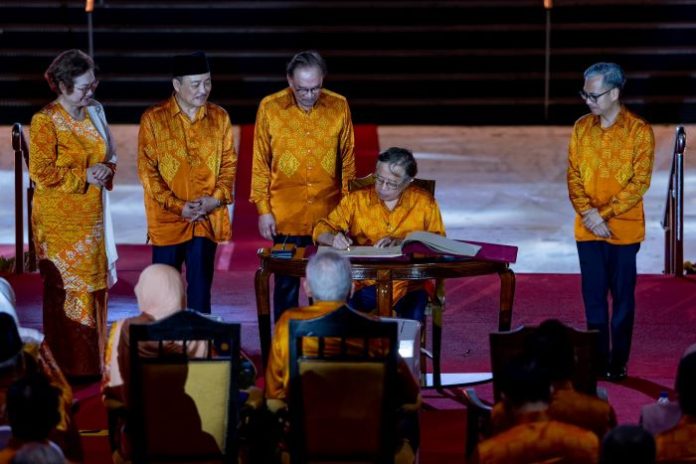
By M. Krishnamoorthy– Malaysians are eagerly waiting for what will be Sarawak Chief Minister Abang Johari Openg strategic move on MA63. To stay united with Malaysia? Or to go independent? Secede?
Prime Minister Anwar Ibrahim’s administration faces significant hurdles in fully implementing the MA63. As PM for all, Anwar has to ensure he does not further alienate Malay support on the peninsula. Most of all he has to get royal assent, say analysts.
On 13th September 2024 (Friday), Anwar sat with Sabah and Sarawak leaders to chair the MA63 Implementation Action Council in Kota Kinabalu. Those in the know say the meeting proceeded cordially, as the Prime Minister was already prepared to announce a piece of good news which some say signifies the Federal Government’s commitment to resolving the MA63 key terms.
Sabah Chief Minister Datuk Seri Hajiji Noor later expressed his elation after Anwar announced an RM300mil increase in the interim special grant – now at RM600mil – from the Federal Government for next year.
The special grant is made pending the resolution of Sabah’s 40% revenue entitlement.
“One of the gravest threats to Malaysian nationhood doesn’t stem from Sarawakian or Sabahan aspirations for independence. The Ketuanan Melayu (Malay supremacy) narratives and Islamisation of government and society by Putra Jaya are a clear and present danger to the existence of the federation as it was originally conceived,” says commentator Murray Hunter.
Now the onus is on the Federal Government to honour thy words on the MA63 Agreement. Efforts are being made to realise the Malaysia Agreement 1963 and experts are stressing the need to honour the promises made to Sabah and Sarawak. Can we expect to see more of the agreement come to fruition?
Resolving the demands in the Malaysia Agreement 1963 (MA63) is more than just realising the key terms spelt out by Sabah and Sarawak when the two regions inked the paper six decades ago to form the Federation of Malaysia with Malaya.
Experts say it is also about honouring the Constitution upholding people’s rights.
Most agree that the 18- and 20-point terms made by Sarawak and Sabah respectively before signing the merger to create the new country remain relevant regarding the two regions’ economic development and administration.
Challenges
Today, despite the challenges after decades of efforts to uphold MA63, several notable milestones have been achieved; most notably the amendment to Article 1(2) of the Federal Constitution in 2021 to elevate the status of Sabah and Sarawak as regions from their previous status as “states”.
Earlier this year, Deputy Prime Minister Datuk Seri Fadillah Yusof announced that nine basic demands based on the MA63 had also been met.
As of now, 14 demands are being looked into, including oil royalty, petroleum cash payments, the regions’ rights to the continental shelves, and an increase in civil service appointments in Sabah and Sarawak under the Federal Constitution’s Article 112.
There are several options ahead for Sarawak, as touted by various groups, says Hunter, the most prominent news and commentary blogger.
Hunter has been involved in Asia-Pacific business for the last 40 years as an entrepreneur, consultant, academic, and researcher.
The options, Hunter says are:
• No change, just stay the same: The latest vote on constitutional amendments, and changing the status of Sarawak. The current discussion on MA63 is likely to fizzle out unless the results of GE15 place Sarawak and Sabah in a strategic position as ‘king makers.’
• Secession-independence: Secession or independence, depends upon one’s interpretation of history, which is beyond this review, as much has been written about the subject. However, an independent Sarawak is a romantic sentimental notion, unless the economics could be substantiated.
• Any leaving of the Malaysian federation would be a long and even potentially violent road. The Malayan elite regrets the loss of Singapore. Any attempt of Sarawak to leave would be met with hyped up security surveillance, arrests, and suppression. The symbolic deployment of the Royal Malaysian Army 10th Rangers in Kuching Sarawak attests to that.
• Any independence would presumably occur after an exercise in self-determination, ideally an independent referendum with international observers. However, even if this currently unimaginable scenario occurred, achieving a positive vote for secession from the federation would not be straightforward.
• Autonomy or greater autonomy: Autonomy is a very wide continuum which in the extreme would mean Putrajaya looking after defence and foreign policy, and the Sarawak government responsible for all other matters.
• Greater autonomy could mean anything from Putra Jaya respecting the 18 points agreement, and/or an additional supplementary agreement specifying more points of autonomy for Sarawak.
“Thus, what is probably more important for Sarawak today is developing a more inclusive notion of politics, democracy, and governance,” says Hunter.
Anwar has repeatedly asserted his wish to fulfil Sabah’s and Sarawak’s rights under MA63, and while there has been progress, some politicians and activists in East Malaysia say it has been a long time coming and still moving too slowly.
“Going forward, I don’t expect the peninsular Malay establishment to be united. So, Sabah and Sarawak will still play a very, very important role,” Professor James Chin, a Professor of Asian Studies at the University of Tasmania, told CNA.
Changing political landscape
Sabah’s deputy chief minister Jeffrey Kitingan, who is also a government-aligned Member of Parliament at the federal level, told CNA that the states’ MA63 demands have finally entered the mainstream political agenda thanks to their kingmaker status amid the changing political landscape.
“It has been 60 years plus since the formation of Malaysia, and we have not yet consummated this partnership fully,” said Kitingan, who was imprisoned in 1991 under the country’s now-defunct Internal Security Act for pursuing Sabah rights at a time when the BN government did not want to hear any of it.
Sarawak’s Premier Abang Johari – a special title reserved for the state’s chief minister – struck a more conciliatory tone, telling CNA in a wide-ranging interview in August that he was satisfied with the federal government’s progress so far in returning Sarawak’s rights under MA63.
Abang Johari said he now senses an “understanding” between federal and state leaders on how to comply with the basic provisions of MA63.
“It’s getting better and better,” he said, adding that Sarawak’s first generation of leaders had, in the two decades after MA63 was signed, focused more on nation-building and unity Government.
The Borneo states’ push for more autonomy as supposedly guaranteed under MA63 now seems to be the strongest in decades ahead of Malaysia Day on Monday (Sep 16), observers said, 61 years to the day the agreement was signed.
MA63 recognises Sabah and Sarawak not as mere states but as equal partners with West Malaysia.
While the Center on Policy Initiatives (CPI) is a nonprofit research and action institute dedicated to creating economic prosperity, and sustainable communities, voiced it its views on the unity that exists in East Malaysian states.
Think Tank
CPI issued a press statement on its online Borneo-centric Think Tank and website.
People in Sabah and Sarawak, of all religious persuasions, gather at the same table in public without the need for any form of religious certification!
We are also very apprehensive about the proposal in which Jakim was considering making halal certification compulsory for restaurants and food establishments that do not serve pork or alcohol. This latest Malaysia Madani policy measure will have serious negative ramifications and ripple effects – intended and unintended – on society and community in Sabah and Sarawak.
We are proud of our multi-religious and multicultural way of life. It is one in which people of all religious persuasions gather at the same table in public and eat, drink and socialise in genuine harmony and unity – without the need for any form of religious certification.
It is unnecessary and regressive to make it compulsory for non-Muslim shops to obtain halal certification; and to place Jakim officers to exercise religious oversight on government agencies in the Borneo region where liberal and secular norms have been the heritage and practice.
We call on the Federal authorities and government to consult and engage with our political, business, social and religious leaders before implementation of these two and other similar policy measures.
We also call on all stake players and stakeholders from Sabah and Sarawak, including the media, to share and disseminate widely their opposition to any unwarranted, ill-advised and politically opportunistic measure of Madani or any other religiously driven policy measure or action.
The peninsula has many pull factors that attract young Sarawakian professionals and skilled workers to the major commercial centres in Klang Valley and elsewhere. This leaves Kuching with a talent vacuum, as many of Sarawak’s best thinkers have been poached. This is partly the reason why social media activism over the future of Sarawak is often led by the Sarawakian diaspora in Australia and the United Kingdom.
Future directions of Sabah Sarawak
The formation of Malaysia was an artefact of anti-colonial sentiment and the Cold War domino theory during the early 1960s. The formation of Malaysia was a way Singapore could gain independence, and North Borneo, and Sarawak could be de-colonised without Indonesia or the Philippines moving against small and young nations, as happened to West Papua.
The formation of Malaysia was a project undertaken by the elites of party states involved, rather than the result of a mass movement, or acts of self-determination. Malaysia was imposed upon Sarawak, and North Borneo, now Sabah by the United Kingdom, without alternative options. Several promises were made to Sarawak and Sabah that have been reneged upon, not lived up to, or ignored. Many in Sarawak and Sabah are left with an empty sense of nationhood, that has led to disappointment.
This has marginalised Sarawak and Sabah more than anything else. The non-Muslim natives of Sabah are now outnumbered by immigrant Muslims from the Philippines and Indonesia.
Issues like the attempt of Malayan political parties to influence politics, an unfair share of revenue from Putra Jaya, lack of infrastructure development, federal interference on educational issues, the rise of state Islam, and the failure of Putra Jaya to honour the 18 and 20 points agreements, have created dissatisfaction among different groups within Sarawak and Sabah.
The focus of many pro-Sarawakian independence activists has been on the 1963 Malaysia Agreement (MA63). Various remedies over the years have been discussed regarding legality, justness, lack of self-determination, and the agreement not being honoured by Putra Jaya.
Sarawak Premier Abang Johari Openg, federal Tourism, Creative Industries, Performing Arts Minister Abdul Karim, and Minister in the Prime Minister’s Department for Sabah and Sarawak Maximus Ongkili stated they believe just honouring the existing MA63 is enough, with adding a supplementary agreement, if necessary.
In the final analysis, political unity is crucial to avoid external manipulation and ensure the effective restoration and implementation of the territory’s rights under MA63.
Freelance Writer M. Krishnamoorthy (www.imkrishna.net) is a media coach, adjunct professor and undercover journalist. He has freelanced with BusinessToday, Bernama, NST, The Star, and Malaysiakini. He also freelances as a fixer/coordinator for CNN, BBC, German and Australian Television networks and the New York Times. As an undercover journalist, he has highlighted society’s concerns