
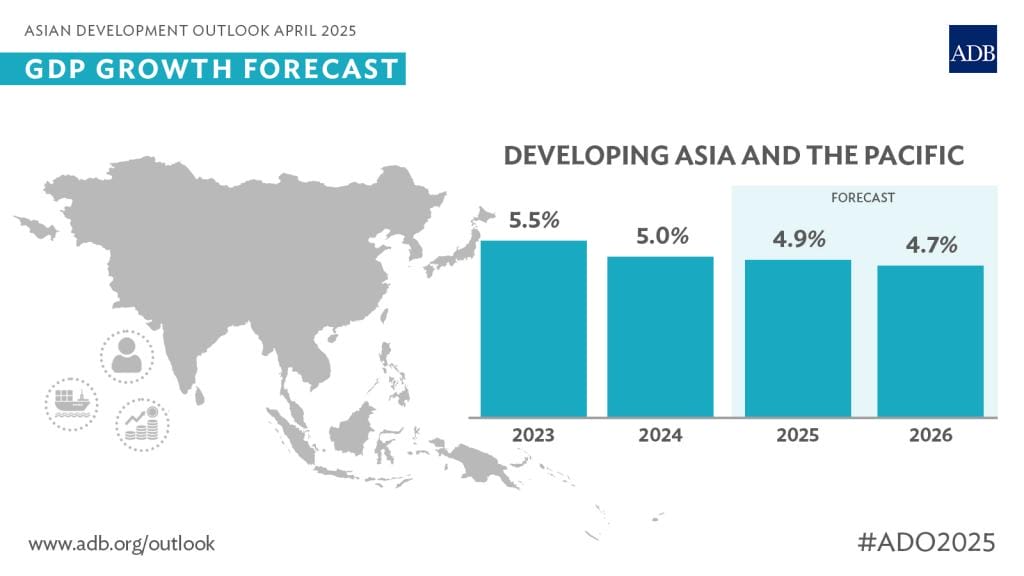
The Asian Development Bank (ADB) said economies in developing Asia and the Pacific are projected to grow 4.9% this year, down from 5% last year, due to trade uncertainty and US tariffs.
ADB said that according to the Asian Development Outlook (ADO) April 2025, the regional growth is expected to decline further to 4.7% in 2026.
“Although solid domestic demand and strong global appetite for semiconductors driven by the artificial intelligence boom are supporting growth, trade uncertainty and US tariff will act as a headwind.
“Inflation is projected to moderate to 2.3% this year and 2.2% next year as global food and energy prices continue to decline,” ADB said.
ADB Chief Economist Albert Park highlighted that the growth forecasts were finalised before the April 2 announcement of new tariffs by the US administration.
“The baseline projections only reflect tariffs that were in place previously.
“However, ADO April 2025 does feature an analysis of how higher tariffs may affect growth in Asia and the Pacific,” Park said.
He added that the report also noted that while economies in the region are resilient, faster and larger-than-expected changes in US trade and economic policies pose risks to the outlook.
“Rising tariffs, uncertainties about US policy and the possibility of escalating geopolitical tensions are significant challenges to the outlook.
“Asian economies should retain their commitment to open trade and investment, which have supported the region’s growth and resilience,” he shared.
Meanwhile, the ADO report also highlighted that stronger growth in South Asia and Southeast Asia, driven by domestic demand and a continued recovery in tourism elsewhere in the region, will partly offset the slowdown in China.
“India, South Asia’s largest economy, is projected to grow by 6.7% this year and 6.8% next year. Economies in Southeast Asia are forecast to grow by 4.7% this year and next year,” the report stated.
Weak external demand, on the other hand, is expected to weigh on economic activity in the Caucasus and Central Asia, with growth projected to slow from 5.7% last year to 5.4% this year and 5% next year.
“For the Pacific, tourism will continue to support growth but at a slower pace, which is forecast at 3.9% this year and 3.6% next year, compared to 4.2% last year,” it stated.