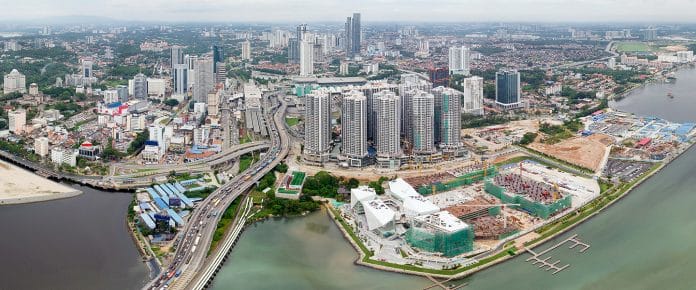
The Johor-Singapore Special Economic Zone (JS-SEZ) continues to gain momentum as both countries reaffirmed their commitment to deepening cross-border cooperation and facilitating investment at the second JS-SEZ Joint Investment Forum held in Singapore on 14 October 2025.
The meeting brought together policymakers, investors, and industry leaders to review progress on the landmark bilateral initiative and identify opportunities to further streamline trade, mobility, and industrial collaboration between the two neighbours.
Singapore’s Deputy Prime Minister Gan Kim Yong revealed that companies from Singapore have committed approximately S$5.5 billion (RM19 billion) in investments into Johor since the signing of the Memorandum of Understanding (MoU) in January 2024.
Gan said the Singapore government has set up a JS-SEZ project office comprising representatives from the Ministry of Trade and Industry (MTI), the Economic Development Board (EDB), and Enterprise Singapore (ESG) to coordinate efforts and support businesses exploring opportunities in Johor.
Malaysia Announces New Business-Friendly Measures
Malaysia’s Minister of Investment, Trade and Industry (MITI), Tengku Datuk Seri Zafrul Aziz, announced a series of measures aimed at accelerating business approvals, easing mobility, and expanding financing options for investors in the JS-SEZ.
Among the key initiatives are Fast-track manufacturing approvals: Licences for non-sensitive industries will be issued within seven working days, followed by a no-objection certificate from the Johor government within another seven days.
Multiple-entry investor visas: New 12-month multiple-entry visas for investors will be available through the Xpats Gateway platform, with the Malaysian Investment Development Authority (MIDA) empowered to proactively offer investor passes to multinational and high-value sector investors.
Talent development funding: An allocation of RM650 million has been earmarked for the Skills Development Fund Corporation (PTPK) to enhance workforce training in line with industry needs.
Strategic co-investment fund: An additional RM200 million has been channelled into the Strategic Co-Investment Fund under the New Industrial Master Plan 2030, with a matching ratio adjusted to 1:1 and financing rates as low as 0.5%.
Record Investments in Johor
Johor’s Chief Minister Datuk Onn Hafiz Ghazi reported that the state has attracted RM56 billion in investments to date, the majority channelled into JS-SEZ-related developments. He added that Johor is on track to achieve RM100 billion in total investments in 2025, the highest ever recorded for the state.
Onn Hafiz also shared that the JS-SEZ blueprint is expected to be completed by the first quarter of 2026, paving the way for more structured implementation.
Cross-Border Synergies and Talent Development
Discussions at the forum highlighted the “twinning model”—where companies operate in both Singapore and Johor—to optimise supply chains and costs.
According to the EDB, companies investing in Johor generally fall into three categories:
- Singapore-based firms expanding operations regionally.
- New entrants to Southeast Asia leveraging Johor’s competitive environment.
- Regional distributors tapping Johor’s strategic logistics advantage.
Notable Singapore-linked investors include Kuehne+Nagel, ResMed, Alpine Renewables & Edible Oils, Archisen, Olam Food Ingredients (ofi) and Sin Chew Woodpaq.
A major focus of the discussions was talent development. The Johor Talent Development Council is collaborating with local institutions and global universities—including from the US and UK—to strengthen technical and leadership training.
While external challenges such as U.S. tariff uncertainties persist, OCBC Research observed that the JS-SEZ remains a bright spot for Malaysia-Singapore cooperation. Progress in 2025—particularly in connectivity, policy coordination, and regulatory efficiency—continues to position the SEZ as a catalyst for intra-regional growth heading into 2026.
“We continue to see the JS-SEZ as a significant opportunity to bolster intra-regional growth as external headwinds build into 2026,” said Lavanya Venkateswaran, OCBC’s Senior ASEAN Economist.