


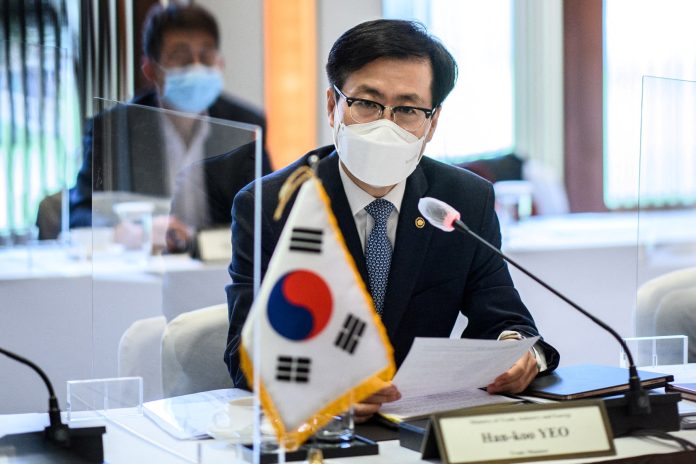
South Korea’s trade minister on Jan 17 sought to calm market concerns after Washington unveiled a 25% tariff on select advanced artificial intelligence (AI) chips, saying the move should have limited short-term impact on Korean exporters, Reuters reported.
“The first-phase measures announced so far focus on advanced chips made by Nvidia and AMD,” Trade Minister Yeo Han-koo said, noting that memory products — South Korea’s key export category — are currently excluded.
“The immediate impact is expected to be limited,” Yeo emphasised.
However, he warned that it was “not yet time to be reassured”, citing uncertainty around timing and scope of a potential second phase. Seoul will coordinate closely with industry to safeguard Korean chipmakers, he added.
US President Donald Trump’s proclamation targets certain high-performance AI semiconductors such as Nvidia’s H200 and AMD’s MI325X, following a nine-month national security probe under Section 232 of the 1962 Trade Expansion Act.
The White House described the action as narrow, saying tariffs would not apply to chips destined for US data centres, startups, consumer tech, civil industrial uses or public-sector applications.
But a broader drag looms as the fact sheet signalled future tariffs on wider categories of semiconductors and derivative products to spur domestic manufacturing, a core pillar of Washington’s reshoring agenda.
Adding to the pressure, US Commerce Secretary Howard Lutnick reportedly warned that South Korean and Taiwanese chipmakers not investing in US production could face tariffs of up to 100%, unless they commit to expanding capacity on American soil. His comments came during Micron’s groundbreaking ceremony for a new plant in New York.


