


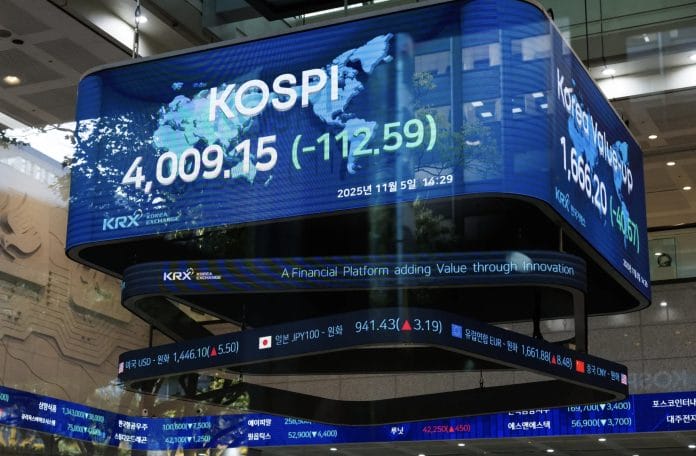
South Korea’s benchmark KOSPI index plunged more than 8% shortly after the opening bell on Monday, triggering a 20-minute circuit breaker as investors dumped technology and heavyweight stocks amid growing concerns over inflation and the prospect of higher interest rates.
The KOSPI fell 683.13 points, or 8.37%, to 7,477.46 as of 9.30am local time after dropping nearly 9% earlier in the session. The sharp decline prompted the Korea Exchange to activate a circuit breaker just three minutes after trading began, while a sell-side sidecar was also triggered on the tech-heavy KOSDAQ market.
The sell-off followed a weak performance on Wall Street last Friday, where semiconductor stocks suffered their biggest one-day decline since March 2020. Investors were rattled by a stronger-than-expected US jobs report, which fuelled fears that the US Federal Reserve could adopt a more hawkish stance on interest rates.
The Dow Jones Industrial Average fell 1.35%, while the S&P 500 lost 2.64% and the Nasdaq tumbled 4.18%. Major chipmakers led the decline, with Nvidia dropping 6.2%, Broadcom falling 7.92% and Micron Technology sliding 13.25%.
In Seoul, technology counters bore the brunt of the selling pressure. Samsung Electronics plunged 8.51%, while SK Hynix fell 7.29%. AI-focused investment firm SK Square slumped 9.78% and LG Electronics tumbled 12.54%.
Other major decliners included Hyundai Motor, which fell 9.71%, SK Group, down 10.72%, and Samsung SDI, which lost 10.21%. Samsung Life Insurance declined 12%, while Doosan Enerbility shed 8.37%.
The Korean won also weakened sharply, trading at 1,554.6 against the US dollar, down 15.5 won from the previous session, reflecting heightened risk aversion across financial markets.


