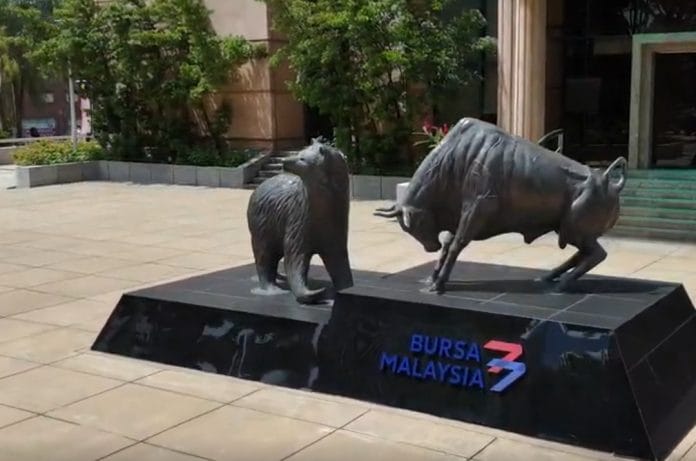
Hong Leong Investment Bank (HLIB) Research expects Bursa Malaysia to remain resilient despite mounting geopolitical tensions in the Middle East, although it cautioned that rising political uncertainties at home and abroad could keep the benchmark FBM KLCI range-bound in the near term.
The research house said volatility is likely to persist as investors assess developments in the Middle East, the start of the US second-quarter earnings season and key US economic data that could influence the Federal Reserve’s monetary policy outlook.
Asian equity markets came under heavy selling pressure after renewed conflict between the United States and Iran sparked fears of oil supply disruptions.
South Korea led regional losses with a 9% decline, followed by China, which fell 2.1%, and Japan, down 1.9%, as investors shifted to risk-off assets amid escalating tensions.
The sell-off followed Iran’s intensified missile and drone attacks on Gulf states and its declaration that the Strait of Hormuz was closed, raising concerns over disruptions to one of the world’s most important oil shipping routes.
Wall Street also retreated, with the Dow Jones Industrial Average falling 0.26%, the S&P 500 declining 0.79% and the Nasdaq Composite sliding 1.55%.
Technology and artificial intelligence-related semiconductor stocks led the decline as investors grew increasingly concerned about higher energy prices and inflation.
Brent crude oil jumped 9.6% to US$83 per barrel, while the US 10-year Treasury yield climbed six basis points to 4.62% amid expectations that higher oil prices could complicate the Federal Reserve’s policy path.
Despite the regional weakness, Malaysia’s stock market outperformed.
The FBM KLCI rose as much as 11.6 points during the session before closing 7 points, or 0.41%, higher at 1,698.4.
HLIB attributed the gains to bargain hunting in plantation and commodity-related heavyweights, which benefited from stronger crude oil prices.
The research house also noted that the market absorbed a higher political risk premium following Barisan Nasional’s landslide victory in the Johor state election on July 11, which has fuelled speculation of an earlier-than-expected 16th General Election.
Foreign investors turned net sellers after three consecutive sessions of buying, recording net outflows of RM34 million.
Local institutions and retail investors, however, provided support to the market, with institutions recording net purchases of RM24 million while retail investors bought RM10 million worth of equities.
From a technical perspective, HLIB said the KLCI’s recent rally has improved the market’s near-term outlook.
The benchmark index has reclaimed both its 200-day moving average and the 50% Fibonacci retracement level after gaining 20.8 points over the past two trading sessions.
Momentum indicators, including the Moving Average Convergence Divergence (MACD) and Relative Strength Index (RSI), also continue to strengthen.
However, HLIB said a decisive break above the 1,705 level is required to confirm a sustained trend reversal.
Should that occur, the index could advance towards 1,715, followed by 1,730 and eventually the 1,750 level.
Failure to overcome the resistance may see the benchmark remain range-bound, with immediate support at 1,679 and stronger support near the year’s low of 1,655.
Looking ahead, the research house expects investor sentiment to remain sensitive to geopolitical developments, corporate earnings announcements in the United States and Federal Reserve Chair Kevin Warsh’s congressional testimony.
Domestically, HLIB said political attention is likely to remain focused on the implications of Barisan Nasional’s Johor victory, with speculation surrounding an early general election, as well as upcoming state polls in Negeri Sembilan and the possibility of elections in Melaka.
While improving technical indicators provide support for the market, the research house believes the elevated political risk premium could limit further gains and prolong the KLCI’s consolidation phase.