Rafizi Ramli has big messages for political party’s in this country and among them is transparency in party funding.
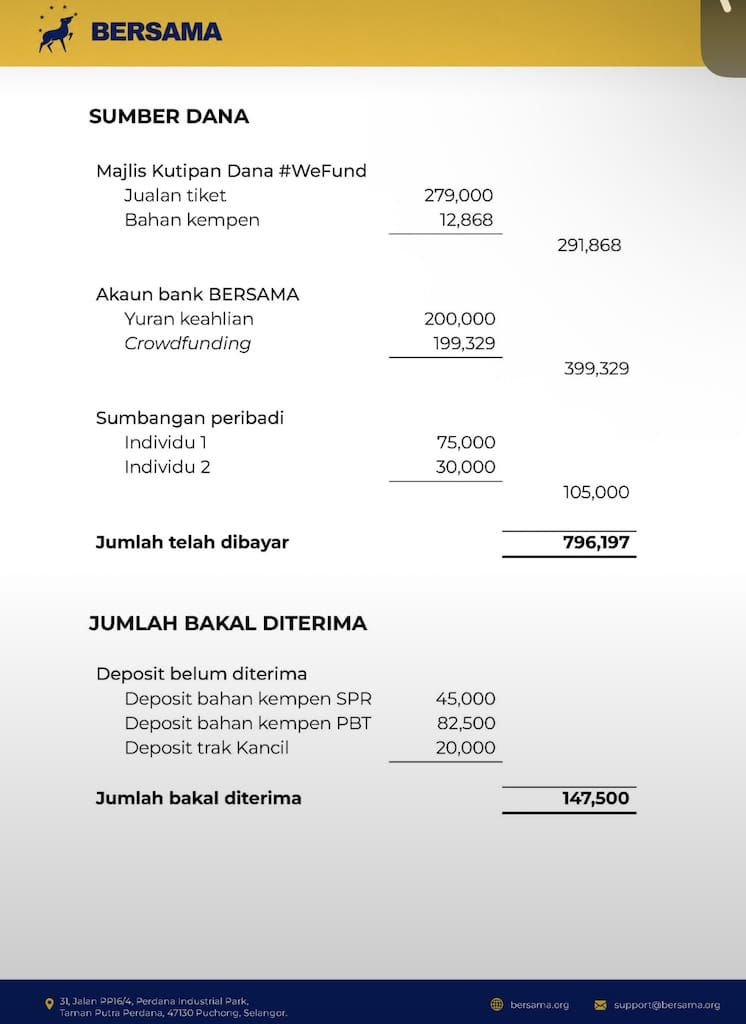
Today the former Economic Minister and Bersama party President published the full financial accounts for the recent Johor state election campaign giving full access to how the funds were secured, where they were spent and what is left in bank account.
In a statement, Rafizi said the newly formed political party was introducing a “new political culture” by voluntarily disclosing the sources of its campaign funds and how the money was spent during the Johor state election.
He argued that transparency in political financing is essential to combating political corruption, saying anti-corruption rhetoric and repeated promises of legislative reforms had failed to address the root causes of the issue.
“Political parties have alternated in governing the federal and state governments, but political corruption continues,” he said.
According to Rafizi, Bersama’s Johor election campaign was financed entirely through three funding sources: annual membership fees of RM20 per member, proceeds from its #WeFund fundraising dinners, and small donations from supporters through crowdfunding and personal contributions.
He said all campaign activities were carried out by volunteers without payment, marking a departure from what he described as common campaign practices among established political parties.
Rafizi claimed many political campaigns continue to rely heavily on paid machinery, including campaign workers, polling and counting agents, as well as monetary incentives to encourage attendance at campaign events.
He cited the Johor state election as an example, alleging that some polling and counting agents (PACA) were paid as much as RM700 per person, including travel and accommodation allowances, while others were compensated on an hourly basis.
Rafizi also criticised what he described as the growing use of government agencies, public assets and taxpayers’ funds for election campaigning by major political coalitions.
Although he did not name any specific parties, he alleged that the practice had become widespread among Malaysia’s major political blocs and was increasingly accepted by the public.
He further claimed that excessive campaign spending—often running into tens or even hundreds of millions of ringgit during state elections—creates opportunities for vested interests to finance political campaigns in exchange for future government contracts or regulatory favours.
According to him, such arrangements could also lead to inadequate enforcement against illegal activities, including online gambling and smuggling, where illicit funding is involved.
Rafizi described political financing reform as one of his greatest disappointments during his previous political career, saying he had been unable to change entrenched practices within political parties or convince Malaysians to reject money politics.
He said Bersama was seeking to build a volunteer-driven political movement centred on integrity and public service rather than financial incentives.
“As we restart our political journey through Bersama, we want to cultivate political activists who genuinely reject corrupt practices,” he said.
The party’s publication of its Johor campaign accounts, he added, would become a standard practice for all future elections contested by Bersama.