


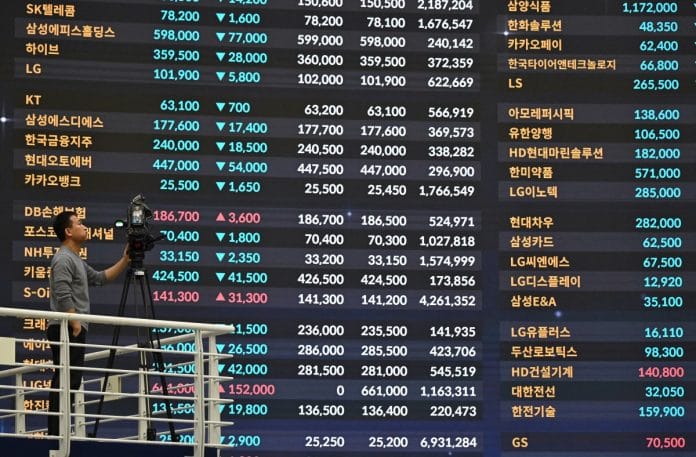
Asian markets surged on Friday alongside Wall Street as investors regained confidence in artificial intelligence (AI)-related stocks after a sharp sell-off earlier in the week, while the yen remained under close watch following suspected currency intervention by authorities.
South Korea led the regional rebound, with the Kospi jumping 14% shortly after the market opened, reversing heavy losses from earlier in the week. Japan’s Nikkei also advanced 5%, while MSCI’s broadest index of Asia-Pacific shares outside Japan climbed 3%.
The recovery followed strong performances from major US technology companies, particularly Microsoft and Amazon, whose upbeat earnings and forecasts helped ease concerns over heavy AI infrastructure spending.
Fabien Yip, a market analyst at IG, said the recent market weakness appeared excessive as investors reassessed concerns over AI-related capital expenditure.
“Both the earnings as well as the sentiment are kind of coming back a bit after the really overexaggerated move in the earlier part of the week,” he said.
“The AI demand story didn’t really decelerate, it seems like it’s still sustainable. So the selloff that we saw… is maybe the market overreacting to some of those concerns around (capex spending).”
Despite Friday’s rebound, South Korea’s Kospi remained on track for its worst monthly performance since 1997, with the index still expected to record a 24% decline in July following a volatile period for AI-linked shares.
Meanwhile, investors continued monitoring the yen after Japan intervened in the foreign exchange market to support the currency ahead of the Bank of Japan’s (BOJ) policy decision.
The yen weakened 0.6% to 160.51 per US dollar on Friday, giving up some of Thursday’s 2.4% surge after intervention measures pushed the currency away from a 40-year low.
South Korea’s foreign exchange authorities also conducted dollar-selling intervention on Thursday, while reports suggested US authorities had carried out “rate checks”, raising speculation of coordinated efforts to stabilise currencies.
“The brutality of the move – USD/JPY falling from near-164 to sub-160 in a sharp jolt – is as poignant as the timing, just ahead of today’s BOJ meeting,” said Vishnu Varathan, head of APAC macro strategy at Mizuho.
“The timing is no coincidence. Clearly the authorities are pre-emptively warning or insuring against JPY selloff on an expected BOJ hold.”
In other markets, long-term US Treasury yields remained elevated near 19-year highs, while short-term yields eased as investors continued assessing the Federal Reserve’s inflation outlook.
Oil prices edged higher amid continued Middle East tensions, with Brent crude futures rising 0.4% to US$89.38 per barrel, while US crude gained 0.3% to US$83.84 per barrel.
Spot gold eased 0.2% to US$4,094.28 an ounce as investors balanced geopolitical risks with shifting expectations on interest rates.
Reuters


