


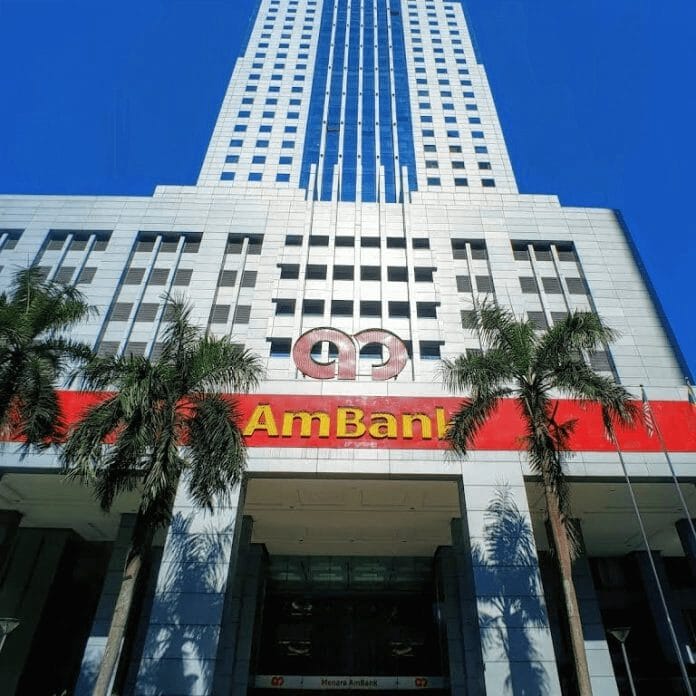
AmBank Group’s net profit for the first quarter ended June 30, 2026 (1QFY27) came in at RM520 million, accounting for about 24% of Kenanga Research’s and Bloomberg’s full-year forecasts.
In a research note, Kenanga said the bank’s pre-provision operating profit (PPOP) continued to show solid growth quarter-on-quarter, although the improvement in its bottom line was partly constrained by a normalisation in credit costs to 19 basis points (bps) in 1QFY27.
Kenanga maintained its ‘Outperform’ call on AMMB Holdings Berhad and its target price of RM7.75.
The research house noted that AmBank had taken RM52 million in overlays against accounts exposed to the Middle East conflict. This was more than offset by RM81 million in writebacks from its retail portfolio, reflecting manageable risks from mortgage and auto loans.
Kenanga believes the writebacks are sustainable, pointing to stable Stage 2 loans, which are considered a precursor to non-performing loans (NPLs), over the past several quarters.
The bank’s loan loss coverage, including regulatory reserves, also remained stable at slightly above 100%. Kenanga retained its credit cost assumption at 18 bps.
Asset growth accelerates
AmBank’s assets expanded 3.1% quarter-on-quarter in 1QFY27, marking its fastest quarterly growth since FY24 and bringing its leverage ratio to 10 times equity from 9.6 times in the previous quarter.
Kenanga said the increase followed AmBank’s strategy of nudging up leverage, with the additional assets channelled predominantly into domestic government securities.
While Malaysian Government Securities (MGS) yields edged higher in July and August, Kenanga remained comfortable with the exposure, given its forecast for the 10-year MGS yield to ease to 3.60% by end-2026.
Around half of the increase in securities was placed in the fair-value-through-other-comprehensive-income (FVOCI) portfolio, meaning fair-value movements are reflected through reserves rather than directly in earnings.
AmBank also increased its exposure to foreign government securities to 3% of total investments.
Kenanga estimates that the bank could generate around a 1% additional yield by recycling three-year MGS into US Treasuries, assuming an average seven-year tenure.
Overall, the research house expects the increase in investment securities to contribute to around 3% growth in profit after tax and minority interests (PATMI), excluding marked-to-market movements.
Investment securities drive NII growth
Kenanga said investment securities income played a bigger role than loans in driving AmBank’s 4% year-on-year growth in net interest income (NII).
Loan growth remained healthy at 7% y-o-y, led by an 11% increase in business banking loans and a 19% expansion in wholesale banking loans, although the latter was from a smaller base.
The key challenge remained net interest margin (NIM), which contracted by 8 bps y-o-y to 1.93%.
On a sequential basis, business banking loan growth also cooled, expanding 1% in 1QFY27.
Meanwhile, expenses declined 2% y-o-y, allowing AmBank’s cost-to-income ratio (CIR) to improve to 43.4%.
However, Kenanga noted that AmBank expects income and expenses to grow at a broadly similar pace by the first half of the financial year, suggesting that spending could become more backloaded, particularly on technology investments.
Kenanga maintained its earnings forecasts, noting that its previous estimates had already assumed higher leverage at AmBank.
The research house also retained its target price of RM7.75, based on an unchanged Gordon Growth Model-derived price-to-book value (PBV) multiple of 1.15 times.
The valuation assumes a cost of equity of 9.4%, terminal growth of 3% and return on equity of 10.2%, against its CY26 forecast book value per share of RM6.75.
Kenanga’s dividend per share forecast of 52 sen for FY28 comprises a 42 sen regular dividend and an additional 12 sen payout.
It said key risks to its positive view include a larger-than-expected squeeze on margins, weaker loan growth, deterioration in asset quality, and a slowdown in capital market activities.


