


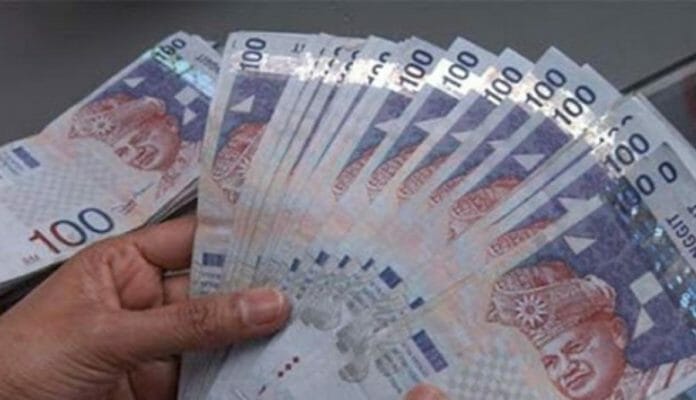
The ringgit is expected to remain range-bound against the US dollar in the near term as investors await key US economic data for clearer signals on the Federal Reserve’s interest rate path, according to Kenanga Research.
The ringgit ended Thursday at 4.043 against the US dollar, weakening from 4.025 last Friday after touching 4.046 amid a hawkish repricing of Fed expectations.
Kenanga said Warsh’s Jackson Hole message and an escalation in US-Iran tensions pushed up short-term US interest rates and oil prices, putting pressure on the Malaysian currency.
The ringgit weakened to 4.046 on Wednesday before stabilising at 4.043 as a stronger Japanese yen pulled the US dollar broadly lower.
Despite the firmer dollar backdrop, Kenanga said emerging-market currencies, including the ringgit, continued to receive some support from the so-called debasement trade.
Rising longer-term US Treasury yields continued to point towards further Treasury buybacks, which Kenanga said could cap the dollar’s upside and support emerging-market foreign exchange carry trades.
Attention now turns to the US non-farm payrolls report, with Kenanga noting expectations for employment to increase by 55,000 jobs, following a contraction of 23,000 in July.
The jobs report opens a data-heavy period that will also include the US Producer Price Index (PPI) and, more importantly, the Consumer Price Index (CPI) on Sept 11.
Kenanga expects US CPI to increase 0.2% month-on-month, in line with market consensus.
The research house said the inflation reading would be the key test for expectations surrounding the Fed’s September policy decision, particularly after recent shifts in rate expectations.
Developments in the US-Iran conflict and their impact on global oil prices will also remain closely watched.
Meanwhile, an expected 25-basis-point rate hike by the European Central Bank is likely to have only limited spillover effects on the ringgit, Kenanga said.
Kenanga maintained its view that the Fed will keep interest rates unchanged in September, with its first rate cut expected only in the second quarter of 2027.
The research house interpreted Warsh’s Jackson Hole speech as a test rather than a clear signal of an imminent policy shift.
While higher crude oil prices are lifting headline inflation, Kenanga said the inflationary impulse remained relatively narrow.
It argued that raising interest rates in response to an oil shock could weaken US domestic demand without addressing the underlying source of higher oil prices.
With forward guidance withdrawn, individual economic releases have become more important to markets, leaving investors reluctant to take significant positions ahead of the CPI report.
An inflation reading in line with expectations could see the US dollar-ringgit exchange rate retest 4.030, Kenanga said.
However, evidence that inflation is broadening across the US services sector could push the exchange rate towards 4.060, implying renewed weakness in the ringgit.
From a technical perspective, Kenanga described USD/MYR as neutral and consolidating around its five-day exponential moving average of 4.040.
The seven-day Relative Strength Index stood at 45.8, indicating no clear directional momentum.
Kenanga identified 4.049 as the immediate resistance level and 4.030 as support, suggesting the ringgit could remain confined to a relatively narrow trading range until US economic data provides a stronger catalyst.


