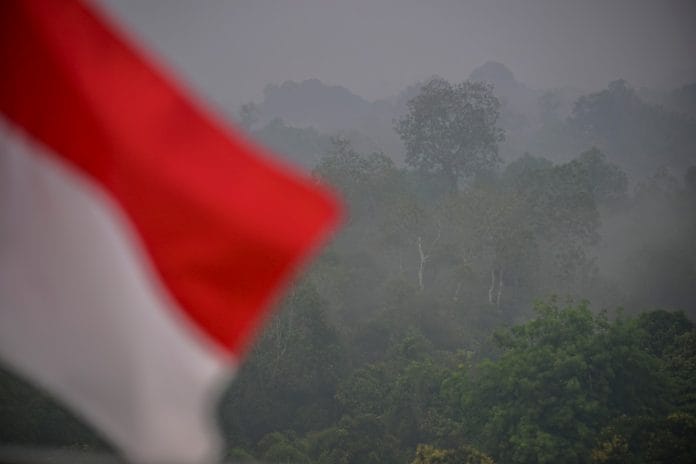
Indonesia is expanding its wildfire response as severe air pollution continues to affect parts of the country and haze spreads to neighbouring Malaysia and Singapore.
The Indonesian National Disaster Mitigation Agency (BNPB) has expanded firefighting operations beyond six priority provinces to other high-risk areas, including parts of East Java, North Maluku, Central Java, North Kalimantan, Central Sulawesi, Lampung and Southeast Sulawesi.
Water-bombing helicopters have also been deployed to areas including Bromo Tengger Semeru National Park and Mount Butak in East Java, according to state news agency Antara.
BNPB acting head of its Disaster Data, Information and Communication Centre Berton SP Panjaitan said the expanded operations were being carried out ahead of forecasts for denser haze and aimed at preventing fires from causing wider damage.
“We’ve seen a surge in hotspot activity and smoke intensity in several areas. We urge everyone to remain vigilant and take precautionary measures against airborne pollutants,” Antara quoted him as saying.
West Kalimantan, Central Kalimantan and South Kalimantan recorded the highest concentrations of air pollutants, with conditions showing little sign of improvement, based on data from Indonesia’s Environment Ministry.
In Central Kalimantan, South Barito recorded an Air Pollution Standard Index (ISPU) reading of 920 as of noon Jakarta time on Wednesday, while Murung Raya recorded 761. Readings above 300 are classified as hazardous under Indonesia’s ISPU system.
Berton said authorities were also closely monitoring wind direction, which has contributed to the spread of transboundary haze towards Malaysia, Singapore and Brunei.
The worsening fires have also been linked to a rise in respiratory infections. Indonesian Health Ministry data showed 113,336 acute respiratory infection cases across Central Kalimantan, West Kalimantan, Jambi and South Sumatra as of Sept 9, more than double the 50,891 cases recorded on Sept 1.
Children aged below five accounted for more than 26,500 of the reported cases.
The haze has also affected air quality in Malaysia, where 40 areas recorded unhealthy readings as of 8am on Wednesday. Johan Setia in Selangor recorded the highest API at 182, followed by Cheras in Kuala Lumpur at 179 and Nilai in Negeri Sembilan at 178.
In Singapore, air quality improved slightly on Wednesday after all five regions entered the unhealthy range on Tuesday for the first time in seven years.
The 24-hour Pollutant Standards Index stood at 99 in the central region at 11am, with the western and eastern regions recording 85 and 83 respectively.
CNA