


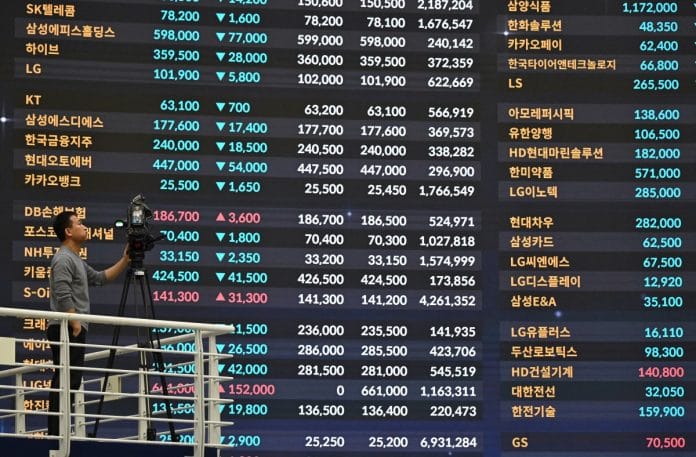
South Korean stocks ended a turbulent week almost unchanged, as a powerful rebound in semiconductor shares and returning foreign buying helped the Kospi recover from an early-week sell-off driven by oil, inflation and geopolitical concerns.
The benchmark Kospi closed at 6,894.23 on Sept 18, down just 15.68 points, or 0.23%, from 6,909.91 a week earlier, despite swinging sharply throughout the five sessions.
The week began on a bruising note, with the index plunging 3.26% on Sept 14 to 6,684.37. Persistently high Middle East tensions, Brent crude trading above US$108 a barrel and warnings from US technology executives over the rapid pace of artificial intelligence (AI) development triggered heavy selling in technology stocks. Foreign and institutional investors sold a combined 4.46 trillion won.
Selling continued the following day, pushing the Kospi down another 0.85% to 6,627.26, its fourth consecutive decline, as macroeconomic uncertainty and caution surrounding the AI sector kept investors defensive.
Sentiment shifted on Sept 16 as investors returned to beaten-down semiconductor heavyweights. The Kospi rebounded 1.37% to 6,717.97, with Samsung Electronics rising 2.01% and SK hynix climbing 4.08% as investors judged the sell-off excessive and remained confident in the memory-chip upcycle.
The market paused on the next day, slipping just 0.04% to 6,715.41, as investors digested the US Federal Reserve’s first interest-rate increase in more than three years. The widely expected quarter-point hike had a limited market impact, while easing oil prices helped temper inflation concerns.
Sept 18 delivered the week’s strongest rebound. The Kospi surged 178.82 points, or 2.66%, to 6,894.23, as falling oil prices eased inflation fears and foreign investors returned as net buyers after seven consecutive selling sessions.
AI and semiconductor momentum remained the key catalyst, allowing Seoul stocks to claw back most of the week’s earlier losses and finish just shy of the Sept 11’s level.


