Home Blog Page 3553

ArtsFAS 2022 Reopens Grant for Malaysia’s Arts And Culture Events!

0

For a limited time, Yayasan Hasanah has reopened grant applications for Arts for All Seasons (ArtsFAS) offering up to RM250,000 for each eligible  applicant. Upon confirmation of eligibility, the application period closes on 30 November 2022. 

The ArtsFAS 2022 grant is open to all arts, culture, and heritage organisations in Malaysia. To qualify, the  proposed public event or showcase must be organised on or before 31 December 2022. 

Providing a platform to showcase Malaysia’s preserved and conserved arts, heritage, and culture via public  events, ArtsFAS aims to educate the younger generation and the larger community through technology,  knowledge exchange and art events, as well as conservation through activation, while making arts accessible for  all. 

To date this year, Yayasan Hasanah has awarded grants amounting RM3 million to 26 arts, culture and heritage  organisations through the ArtsFAS 2022 grant in support of revitalising the creative economy. Through the grants, 1,000 arts, culture and heritage practitioners are expected to benefit from economic opportunities while  treating Malaysian audiences to an exciting series of arts and cultural experience.  

Ongoing now until year end, ArtsFAS 2022, jointly managed with the Ministry of Finance, supports over 50  performances, theatrical productions, workshops, exhibitions, webinars, ensemble performances, and other  events, orchestrated in the Klang Valley as well as nearly all Malaysian states. Last year, the impact-based  foundation contributed RM1.68 million through the ArtsFAS 2021 grant.  

Yayasan Hasanah Managing Director and Trustee, Dato’ Shahira Ahmed Bazari said, “Yayasan Hasanah  continues to support the Malaysian arts, heritage, and culture scene and this year, we are looking to distribute a much larger amount for even more impact-based projects and initiatives by our partners through ArtsFAS, in  collaboration with the Ministry of Finance. We look forward to having fresh applicants who need support for  their performances, exhibitions and even art demonstrations which will be showcasing our rich multicultural  legacy across the country for all Malaysians alike.” 

Submissions for the ArtsFAS grant must reflect the activities to be proposed, list clear objectives and have a detailed budget on how the funding will enable the project to meet its objectives. 

For the full criteria and details on how to apply, visit www.artsfas.org/apply-now

Abang Johari Tables Surplus Budget Next Year For Sarawak

0

Sarawak’s Budget 2023 is expected to generate a surplus of RM238 million with a projected revenue of RM11.035 billion and a total ordinary expenditure of RM10.797 billion.

When tabling the budget at the state assembly here, Sarawak Premier Tan Sri Abang Johari Tun Openg said the budget would continue be expansionary and invest heavily in infrastructures with the wellbeing of the people as its centrepiece.

“In a nutshell, Sarawak Budget 2023 is a strategic, comprehensive, and integrated roadmap to position Sarawak for the future. While the way forward may not be easy, I am confident we can overcome them,” he said.

The proposed budget, themed “Sarawak First: Towards an Inclusive, Prosperous and Harmonious Society,” is anchored on five principles, which include developing a more robust, competitive, and equitable economy;

Abang Johari said 48 per cent, or RM5.246 billion, of the projected revenue next year would be derived from taxes, royalties, premiums, tariffs, land rentals, and others, while non-tax revenue made up another RM5.498 billion.

“Non–revenue receipts are expected to be RM26 million, mainly from unclaimed deposits, overpayment recovered, liquidated ascertained damages and penalties, forest liquidated damages, other compounds, and disposal of vehicles. Federal grants and reimbursements are expected to be at RM265 million,” he added.

For the ordinary expenditure next year, he said RM3.997 billion would be for operation, while RM6.8 billion would be for financing the implementation of various development programmes and projects.

Abang Johari said Sarawak’s economy for this year is expected to grow between 5.5 percent to 6.5 percent through the support of strong external demand and improvement in domestic economic activities.

He added that the Sarawak manufacturing and services sectors are expected to be the main drivers for 2022 with a growth of 6.8 and 7 percent respectively, while the construction sector is projected to grow at 5 percent.

Ringgit Falls 290 Basis Points On Anxiety Over Hung Parliament As US Dollar Edges Higher On Defensive Buying

The ringgit slipped further against the US dollar this morning, extending last week’s downtrend, as the first-ever hung parliament outcome in Malaysia from the 15th General Election (GE15) held last Saturday shook investor confidence, an analyst said.

At 9am, the local note slid 290 basis points (bps) to 4.5780/5880 against the US dollar from Thursday’s close of 4.5490/5565.

The market was closed last Friday to enable voters to cast vote in GE15.

However, SPI Asset Management managing director Stephen Innes reckons that the market would take the general election results in stride given that the hung government was expected.

“So, expect more political horse-trading and compromise in such a setting, which could provide checks and balances, with the focus on the formation of the next government.

“However, from the market’s perspective, the GE15 results may fail to ease concerns over the recent phase of political instability, which had been hanging as a dark cloud over Malaysian capital markets,” he told Bernama.

GE15, the most intense general election the country had ever faced, has ended in a hung parliament with no party securing a clear majority to form a new federal government.

Innes noted that investors have been shrugging off the hawkish US Federal Reserve interest rate hike decisions and peering down the China reopening-looking lens, which should be favourable for local capital markets.

“Also, any weakness in the US Dollar Index (DXY) should encourage exporters to pare down their accumulated US dollar holdings and be a driver of the ringgit’s strength,” he added.

Ambank Research said that the focus of the week would be on the US Federal Open Market Committee (FOMC) minutes that should provide a clearer picture of the interest rates outlook.

“Therefore, we expect the ringgit to trade between our support level of 4.550 and 4.560 while resistance is pinned at 4.600 and 4.610,” it said.

Meanwhile, the ringgit traded lower against a basket of major currencies.

It fell versus the Singapore dollar to 3.3280/3358 from 3.3091/3150 at Thursday’s close, depreciated against the euro to 4.7222/7325 from 4.7146/7224, eased vis-a-vis the Japanese yen to 3.2628/2701 from 3.2581/2637 and down versus the British pound to 5.4323/4441 from 5.4069/4159 previously.

US Dollar Edges Higher

The US dollar started the week on the front foot, boosted by defensive buying as investors remained on edge following a spike in Covid-19 cases in some cities in China that prompted officials to tighten restrictions.

China’s capital Beijing reported two Covid-19 deaths for November 20, with the city’s most populous district urging residents to stay at home today, extending a request from the weekend.

The rising cases have cast doubt on the hopes of an early easing in strict pandemic restrictions.

“The outlook for China’s zero-Covid market will remain a key source of volatility,” said Carol Kong, a currency strategist at Commonwealth Bank of Australia.

“If we do see another set of step up in restrictions, it indicates to me that the Chinese officials are still wary of any eventual reopening.”

The dollar index rose 0.131 per cent to 107.030 today, after logging its biggest weekly gain in a month last week, while the offshore Chinese yuan rate was at US$7.1700 per dollar, Reuters cited.

Hawkish comments from the Federal Reserve officials have helped the safe-haven dollar stabilise after its sharp dive earlier in November.

Investors will be keenly interested in the minutes from the Fed’s November meeting due to be released on Wednesday that could shed light on how high officials ultimately expect to raise interest rates.

Meanwhile, cryptocurrencies remained under pressure, with bitcoin down 0.3 per cent to US$16,205.00, while Ether also shed 0.3 per cent. FTX owes its 50 biggest creditors nearly US$3.1 billion, according to bankruptcy filings, as the collapsed crypto exchange undertakes a strategic review of its global assets.

The euro fell 0.21 per cent to US$1.0302, while sterling was last traded at US$1.1851, down 0.30 per cent on the day.

The Japanese yen weakened 0.04 per cent versus the greenback at 140.42 per dollar. The Australian dollar fell 0.25 per cent versus the greenback at US$0.665, while the kiwi was down 0.21 per cent at US$0.614.

For the latest Business News and happenings, follow BusinessToday on Twitter

Female leadership in the age of Industry 4.0

0

The implementation of Industry 4.0 in advancing digital societies across Asia Pacific plays a crucial role in stimulating economic recovery and building resilient economies. But it also highlights the need for leaders to embrace organisational change across the region.

In Malaysia, digital transformation of everything on the factory floor has delivered significant value through data, analytics, artificial intelligence (AI), and machine learning. The arrival of smart manufacturing has also played a critical role in helping increase production capacity and productivity, all while reducing material wastage across the manufacturing value chain.

Although digital transformation has revolutionised the industry, it has also forced changes within processes and people. As a result, many leaders are learning that there is no such thing as a one size fits all approach to transformational change. Instead, it’s the unique culture and values in every factory site and organisation that needs an additional focus to bring digital initiatives to life.

Industry 4.0 is much more than businesses leveraging emerging technologies. Rather than replacing people, the best results occur when technology and human ingenuity complement each other. Thankfully, female leaders in Malaysia are leading the way in ensuring companies adapt to changes brought about by digital transformation.

The value of mentorship

In a world of data-driven decision-making, leadership is less about what is said and more about allowing the data to drive the strategy, work activities, and measuring results. Ultimately, it’s about evolving to a more objective-oriented approach on every implementation. These days, we’re seeing more female leaders enter the male-dominated industry of manufacturing, bringing with them valuable change. 

One of the most significant changes that female leaders bring to Industry 4.0 is being seen as mentors by their teams. By increasing the empowerment of the team and allowing them to drive, participate in and enjoy the process, they can understand the market need and work the proposal to solve customer pain points. 

Mentoring also helps leaders and teams to be more confident. It inspires trust in a working environment where everyone can see their work’s value and how it contributes to the bigger picture. By working as a team to discuss our customers’ issues and future market needs, we can collectively tailor the solution to help our customers, and our people grow.

Strengthening female leadership in the age of Industry 4.0

With the ability to zoom out, we provide different digital tools and services to enable customers to collect and analyse data to help them make better decisions on the procure-to-buy process, supplier consolidation, and strategy negotiation. To increase our customers’ efficiency and cost savings, we must also practice what we preach internally within our teams.

At RS, we are proud that 32% of our leaders and 44% of our Board are female. But we also understand why we need to continuously improve diversity and inclusion across the organisation to unlock greater business value together. By embracing organisational change and implementing the right processes, it becomes much easier to replace silos with the introduction of cross-functional collaboration and empowered decision-making.

For these reasons alone, empowering women with education to further hone their digital and leadership skills should be a priority for every business. Investing time in understanding female leaders’ challenges is essential and providing the resources they need to tackle the obstacles ahead is a great starting point. But we encourage leaders to think even bigger.

Diversity of thought

To successfully lead in a male-dominated industry, a value-driven approach must take precedence, especially as traditional hurdles such as siloed implementation and analysis paralysis make it nearly impossible to adapt to a continuously changing world.

Unlocking the actual value of Industry 4.0 is much more than leveraging new technologies. Sure, the digitally enabled factories of today look very different from a decade ago. But diversity of thought and greater collaboration will provide greater adaptability. Additionally, creating a culture that elevates teams by encouraging communication around individual perspectives and thinking that allows employees to see beyond themselves and their teams paves the way for transformational change.

Diversity and inclusion must be top priorities for any leader serious about transforming their organisation’s culture. To date, 90% of RS staff have completed our global inclusion training module, which was designed to raise awareness of our biases and the impact they can have on the decisions we make as a team. As we continue to reap the benefits of this building this new culture, the training will be mandatory for all new starters in 2023.

We also encourage our teams to think about their impact in the office and ask our employees to take two paid annual volunteering days a year to share their time and skills on a project that makes a difference to the community. Once again, teams need to work to something that’s bigger than themselves.

Female leaders in the age of Industry 4.0 are bringing their compassionate wisdom and humility to the factory floor while also motivating teams through transformation. By eliminating silos and the loudest voice in the room from calling all the shots, we are allowing every individual to see how their work impacts their team, employer, local community, and beyond. 

By Sean Er Lim, Country General Manager (Malaysia), RS

Thailand Had Fastest Pace of GDP Growth in Q3 for More Than A Year

0

Spurred by a revival in tourism and increased consumption, Thailand’s economy grew at its fastest pace in more than a year. Thailand is the second largest economy in ASEAN.

According to data from the National Economic and Social Development Council, Thailand’s economy expanded 4.5 per cent in the September quarter from a year earlier.

On a quarterly basis, gross domestic product (GDP) grew a seasonally adjusted 1.2 per cent in July-September, beating expectations for a 0.9 per cent rise.

The government said the economy would grow 3.2 per cent this year, compared with a previous forecast range of 2.7 per cent to 3.2 per cent.

Meanwhile, 2023 is projected to grow at 3 per cent to 4 per cent.

Thailand reported 1.5 per cent growth last year, which was among the slowest in the region.

Third-quarter growth was in line with expectations for a 4.5 per cent rise and marked an acceleration from the 2.5 per cent growth seen in the April-June quarter.

Thailand’s economy is on a steady recovery path, with growth in the crucial tourism sector gathering pace after the government lifted all COVID-19 curbs earlier this year but the outlook is clouded by risks of slowing global growth and high inflation.

As the central bank tries to strike a tricky balance between containing near 14-year high inflation while supporting the fragile recovery, this robust data on growth will likely to reinforce expectations for a 25-basis-point rate hike at the Bank of Thailand’s meeting

PropertyGuru’s Revenue Surged 47% Year Over Year in the 3Q 2022

0

The Southeast Asia’s leading, property technology (PropTech) company, has announced financial results for the quarter ended September 30, 2022.

The company posted revenue of S$34.6 million in the third quarter 2022 increased 47% year over year. Net loss was S$7.4 million in the quarter and Adjusted EBITDA 3 was a positive S$5.7 million. This compares to a net loss of S$9.6 million and Adjusted EBITDA loss of S$1.5 million in the prior year period.

“Our third quarter results illustrate that PropertyGuru has been able to produce strong business performance even as some of our core markets have begun to face headwinds from the challenging economic conditions being experienced around the globe,” Hari V. Krishnan, Chief Executive Officer and Managing Director said.

“In the third quarter, we deployed more products into our core markets. Importantly, in October we welcomed our first post-listing acquisition, Singapore-based home services technology company Sendhelper, into the PropertyGuru family,” Mr. Krishnan continued.

“This continued commitment to our mission and expansion of our value proposition will allow us to create even more value for our customers as they adapt to the changing environment. We recognize that our ongoing investment in
innovation will help our customers successfully navigate the near-term uncertainty, knowing that good companies and good products show their true value when times are challenging.”

“In the third quarter, PropertyGuru delivered another strong quarter of results, with revenues continuing their growth trajectory, up 47% year-over-year, while expense-related diligence helped deliver improved Adjusted EBITDA,” Joe Dische, Chief Financial Officer remarked.

“We remain encouraged by our market penetration as we enter the final quarter of 2022, although we understand that near-term market headwinds resulting from global inflationary pressures and subsequent governmental counteractions will need to be closely monitored,” Dische added.

“While we are confident in the long-term fundamentals of our business and the growth potential that it offers, we understand that the current environment requires us to be especially diligent in the way we currently operate our business on a day-to-day basis,” Dische said.

As of September 30, 2022, PropertyGuru continued its Engagement Market Share leadership in Singapore, Vietnam, Malaysia, and Thailand.

The Company anticipates full year 2022 revenues of between S$134.0 million 7 and S$138.0 million 6 as a result of greater fiscal policy uncertainty stemming from rising global inflationary pressures, near-term actions by the Vietnamese government to limit access to credit, and the recent Malaysian election.

The Singapore property market remains strong. The Company also expects Adjusted EBITDA to be between S$8.0 million 6 and S$12.0 million, as management operates to balance the current environment with longer-term business model goals.

Contract Renegotiation Spiked 3Q22 Earnings of MISC: MIDF

0

MIDF Research has revised its target price (TP) for MISC as its earning is now back to black. In its research report, it has also raised the main point that MISC reversed its previous losses with profit surging by over 100% on-year and on-quarter to RM820.6m in 3QFY22, from RM401m in 3QFY21 and from a loss of – RM19.1m in 2QFY22.

For the cumulative 9 months, earnings dropped by -14% yoy to RM1.18b. Consequently, MISC’s earnings came in above the research house’s expectation at 97% of full-year estimate. The higher earnings were due to one-off compensation for a contract renegotiation and the gain from the construction of an FPSO.

Revenue up +34% yoy. The group reported a rise in revenue by +34.3%yoy and +12.5%qoq to RM3.61 billion. For the cumulative 9 months, revenue increased by +27.8% to RM9.69b. This is contributed by: (i) higher freight rates for mid-sized tankers, (ii) higher earning days for its Petroleum & Product Shipping (PPS) and Gas Asset & Solutions (GAS) segments, and (iii) higher recognition of construction revenue of an FPSO.

Gas Asset and Solutions. This segment’s revenue rose by +6.6% yoy and +3.6% qoq to RM790.1 million, while profit shot up +13.2% yoy and +7.6% qoq to RM355.1 million. Cumulatively for 9 months, both revenue and earnings are up by +9.1% yoy to RM2.31 billion and +18.5% yoy to RM1.08 billion respectively.

Petroleum & Product Shipping. For the cumulative 9 months, revenue and earnings increased by +39.3%yoy to RM3.28b and +159.6% to RM618m.

Offshore Business. This segment recorded a gain in revenue by +49.4% yoy and +25.8% qoq to RM1.12 billion. However, earnings slipped – 21.9% yoy to RM190-76.7%, but gained >100% qoq from a loss of – RM20.1 million. Cumulatively for 9 months, revenue increased by +38.1% yoy to RM2.78 billion while earnings lost -47.1% yoy to RM354.4 million.

Marine & Heavy Engineering. This segment reported a rise in revenue by +5.1% yoy and +2.1% qoq to RM409.2 million. Meanwhile, earnings surged >100% yoy to RM19 million from a deficit of -RM20.1 million in 3QFY21, but lost -26.4% qoq. For the cumulative 9 months, revenue and earnings gained +18.6% yoy to RM1.23 billion and +134.5% yoy to RM51.1 million respectively.

Robust orderbook. As of 3QFY22, MISC had completed repair & maintenance of 72 vessels of various categories including 8 LNGCs. Additionally, the group was awarded the provision of Front-End Engineering Design (FEED) Competition for the Kasawari Carbon Capture & Storage (CCS) project from PETRONAS Carigali, and a contract from Sarawak Shell Berhad (SSB) to undertake the Engineering, Procurement and Construction (EPC) of the offshore platform for the Rosmari-Marjoram gas project. The group’s orderbook backlog stood at RM2.2b, with approximately RM15-16b-worth of heavy engineering tenders submitted. 2 LNGCs is expected to be completed in 1HCY23, as well as 1 VLCC in 1HCY23 and 2 VLCCs in 4QCY23.

Demand in LNGC surged. Due to increased demand for LNG cargoes as winter approaches and Europe accelerates its FSRU-based LNG import projects, LNGC spot rates increased by 46% qoq in 3QFY22. This had a dampening effect on Asian LNG import and power generation projects. The push for energy security, the rising LNG demand, and the shortage of LNG supply in advance of the winter season all contributed to an increase in time charter prices. As a result, a rise in new orders is anticipated throughout the year, led by the LNGC orders from Qatar and the soaring demand from Europe, which saw 124 vessels ordered in 3QFY22.

Cautious outlook on shipping market. The increase in the FID of planned liquefaction projects and growing demand for LNG are expected to be positive catalysts to MISC’s shipping business. VLCC earnings is expected to rebound due to the increase in US crude flows to the Far East and South Asia.

The uptrend continues in mid-size tanker spot rates due to reshuffling of trade routes prompted by EU’s ban on Russian imports and the greater tonne-mile growth caused by the Russia-Ukraine conflict. Oil supply continues to be tight this winter, capping any rise in freight rates.

The risks to the demand outlook remain to be the disruption in Chinese oil demand and the global economy slowdown. The tanker market orderbook trend remained low due to: (i) high newbuilding prices, (ii) lack of yard space, (iii) prevailing tonnage oversupply, and (iv) uncertainty over decarbonisation targets. Overall scrapping activities remains low despite some slight pickup in the midsize tanker segment.

Offshore activities to recover. Global offshore E&P capex spending is expected to reach USD131 billion this year – an increase of 18% from CY21, with Latin America and Asia Pacific accounting for nearly half of the total. New FPSO projects over the in the near to mid-term are expected to be mostly centered around South America, particularly in Brazil and Guyana.

Revised FY23-24 earnings estimates. With the resiliency in the market and taking MISC’s 3QFY22 earnings into account, MIDF has revised its FY23 and FY24 earnings projection upward by +31% and +23% respectively. As such, target price is revised to RM7.70 (previously RM7.48), by pegging a PER of 21x to a revised EPS23 of 37sen. The PER is based on a 10- year average PER for marine and tankers subsectors.

The research house has retained its NEUTRAL with TP at RM7.70. As global oil demand and supply continue to recover, the research house has stated it remains cautious on MISC’s future prospects, especially on the basis of freight rate hikes and weakening demand from China that could disrupt the timely execution of the group’s projects. Additionally, the volatile oil and gas market due to the ongoing Russia-Ukraine war, the upcoming Russian sanctions and tight crude supply remain to be major risks.

Despite the surge in earnings in 3QFY22, the research house recognises that it is likely a one-off event. Nevertheless, it reiterates its positive view for the group, on the basis of rising demand for both petroleum and LNG in Europe and East Asia; ongoing long-term contracts and resilient orderbook; and the bright prospects in the shipping and tanker market in the near term.

Sin Stock Jittery On PN Prospects

0

With no clear indication of which coalition will form the next government, the prospect of Perikatan Nasional which is predominantly supported by the Islamic party PAS has given selected stocks on the KLCI, jitters.

Risks of the propensity of the government to continue implementing populist policies – rather than the hard decisions that need to be taken in view of the country’s long-term interest – could depend on the size of the parliamentary majority enjoyed by the government.

RHB expects the equity market to trade cautiously in the coming week. While a hung parliament was the base-case scenario, the strong electoral performance by the PN coalition it says was a surprise and expects regulatory risks to spike higher especially for the gaming, brewery, and tobacco sectors.

The research house says investors could remain wary of construction-related stocks, given the sector’s dependence on policy implementation. If an extended power vacuum ensues or if the new government’s policy position on infrastructure remains vague, the KLCON index could face a sell-off to reflect the political uncertainty. Further out, investors should re-focus on fundamentals, with a preference for non-politically aligned, large-cap value stocks

Election Week Sees Foreign Investors Turn Net Sellers

0

Foreign investors turned to net sellers again last week to the tune of -RM272.0m, a reversal from the net inflow of RM425.6m in the previous week. It was a shortened trading week following the public holiday granted on Friday to give way for the 15th General Election last weekend.

In contrast, local institutions were net buyers last week with a total net inflow of RM152.5m with the bulk of it recorded on Tuesday at RM149.9m and Wednesday at RM39.2m. Meanwhile, Monday and Thursday saw local institutions net selling -RM34.3m and -RM2.3m worth of equities respectively.

On the other hand, local retailers turned to net buyers last week with a total weekly net inflow of RM119.6m. This was a positive reversal in comparison with the -RM173.6m net sold in the week prior. Retailers started off the week by net
selling -RM21.3m worth of equities.

International funds have been net buyers for 26 out of the 46 weeks of 2022, with a total net inflow of RM5.91b. Local institutions were net sellers for 31 out of 46 weeks, with a total net outflow of –RM7.99b. Local retailers have been
net buyers for 29 out of 46 weeks of 2022. Year to date, they have been net buyers at RM2.08b.

In terms of participation, MIDF says there was a deterioration in terms of average daily trade value (ADTV) by retailer investors (-8.0%), institutional investors (-3.3%), and foreign investors (-0.1%).

Hung Parliament: Investors Should Look out For Agnostic Stocks

0

The GE15 ended with a hung parliament. At the time of writing, MIDF says it reckons the various political parties are busy trying to form a majority coalition to be presented to the YDP Agong by 2pm today. While equally hopeful that this process would end quickly, however, cannot be ruled out the possibility that it may take days or even weeks to conclude.

In the meantime, expect the equity market to react adversely to this situation with a negative kneejerk reaction
pulling the FBM KLCI lower and possibly breaching its psychological support level of 1,400 points. This is based on previous
experience in GE14.

Followed by a relief recovery. However, once a new government is formed, the market is expected to duly recover. The
strength of the relief rebound would nevertheless be dependent on how stable the new coalition government is perceived
by the market.

Baseline assumption is for PN to form a majority government together with GPS, GRS, and also BN in short order. At this juncture, MIDF says it is keeping the FBM KLCI 2022 year-end target at 1,520 points.

Look for sectors that are more agnostic to politics. Given that market, sentiment may be weak due to the hung parliament in GE15, tactically (at least for this week) the research house believes that investors should look for sectors that are more agnostic towards the result of the election and with good fundamentals that are closely tied with the performance of the economy, such as the banking sector.

MIDF continues to be POSITIVE on the banking sector and going forward, expect banks’ core earning drivers to remain with strong loan growth and leading indicators, an environment still rich with liquidity to support the said loan growth, lower credit costs and OPR hike-related benefits to net interest margins. Additionally, the banking sector is often synonymous with high deposit yields, with several names offering yields above >4%. This should offset headwinds: namely asset quality concerns, normalization of operating expenses, heightened deposit competition, and still weak non-interest income sources.

Xinghuo BIF Appoints MyEG As Infra Partner Connecting China Blockchain To Global Markets

0

China’s national blockchain, Xinghuo Blockchain Infrastructure, and Facility have inked an agreement with MY E.G. Services Bhd for MyEG to own and operate the Xinghuo International Supernode (Malaysia) that will provide connectivity to the rest of the world.

The agreement is set to allow cross-border adoption and utilisation of the latest Decentralised Identifier standard (BID) to gradually create the Web3 of China and beyond. Xinghuo BIF is a global blockchain infrastructure devoted to a trustworthy digital foundation for the world. Up till now, 7 Xinghuo BIF supernodes cover the main areas in China and 29 backbone nodes provide services to a broader range of industries and cities. Xiamen and Liuzhou Supernodes, Jiaozhou (Shandong) and Hengqin (Guangzhou) backbone nodes empower cross-border trade and provide international service overseas. International
enterprises including SAP and Siemens partnered with Xinghuo to promote global blockchain innovative applications. Presently, Xinghup BIF resolves approximately 100 million blockchain identifiers daily, placing it as the most actively used blockchain platform globally.

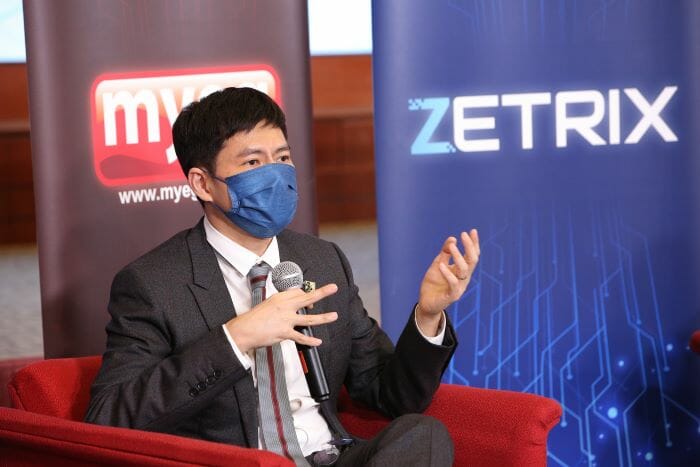
The international supernode will connect to MYEG’s layer-1 permissioned public blockchain, Zetrix, which is fully compatible with Xinghuo. This enables Zetrix network’s on-chain assets and transactions to cross seamlessly into Xinghuo, connecting governments, businesses and their people to a global blockchain-based economy. Commenting on the partnership, Xiaohui Yu, President of CAICT said,” We should cooperate more in building node network, seize the opportunity presented in the next generation of Internet and empower industries with blockchain and other technologies, thus providing solid
infrastructure and advancing innovative development.”

The agreement marks a milestone achievement in Xinghuo BIF’s global expansion since the Memorandum of Understanding that was signed back in 2021. The international supernode will connect to MYEG and develop blockchain infrastructure applications, which will increase the interconnectivity of infrastructure in countries, and enhance the capability of cross-chain operation. With its technologies and public service capabilities, Xinghuo BIF will provide blockchain services to Malaysia and other ASEAN countries and assist in cross-border commodity tracing, identity verification, and supply-chain finance.

Wong Thean Soon, Group Managing Director of MYEG and co-founder of Zetrix said,”Xinghuo BIF is already the most advanced and heavily utilised chain for industrial and trade applications. Now with the commencement of the Xinghuo International Supernode, the rest of the world can connect and be part of the China Web 3 evolution that will promote the
establishment of international communities and facilitate global trade and finance.” Xinghuo BIF and MyEG’s layer-1 public blockchain, Zetrix, had previously announced the introduction of cross chain Blockchain Identifiers (BID), Verifiable Credentials (VC), and on Chain Agreement signing. BIDs and VCs are critical building blocks of more interconnected Web 3, as they are the foundational tools that decentralised apps can call upon to deliver a myriad of new services.

The agreement between the parties was befittingly signed on-chain using Zetrix’s blockchain digital signing service.

Women Rule The Roots In Kelantan’s Business Sector

0

From roadside stalls to popular stores, most of them are operated by women. In many Kelantan households, women not only control the purse strings but are also the principal income generators with a majority of them involved in businesses.  

The famous Siti Khadijah Market in Kota Bharu is a testament to the economic power wielded by the women of this state. Over 90 percent of the 2,400-odd traders operating there comprise women who slog diligently from dawn operating their stalls at the wet market section or selling groceries, food items and even clothes and gold jewellery.

Their ages ranging from 20 to 70, most Kelantan women entrepreneurs have business in their DNA, having inherited the skills from their mothers and grandmothers.

According to Siti Khadijah Market Bumiputera Petty Traders Association secretary Norazma Mohd Jaafar, in Kelantan, it is not unusual to see women figuring more prominently than men in businesses.

The clothing entrepreneur said women, in fact, contribute a great deal to the state’s economic development as they are involved in almost every part of the supply chain.

To cite an example, the serunding daging (meat floss) sold at the Siti Khadijah Market is supplied by (women) serunding operators from around the state such as Kampung Laut, Tumpat. So the latter also benefit when business flourishes at the main market,” she told Bernama.

HARDWORKING

The Siti Khadijah Market, which opened in 1985, has not only grown into an iconic tourism product but has also become a symbol of the Kelantan women’s steadfast commitment to succeeding in business.

The market is visited by 1,000 to 2,000 people a day during the festive season and school holidays. On other days, it receives about 500 to 1,000 visitors daily.

The three-storey building housing the market also serves as a centre for the collection and sale of agricultural produce, seafood and products generated by small and medium enterprises throughout the country. Even merchandise from neighbouring Thailand can also be found here.

Showing support for the indomitable spirit and perseverance of Kelantan’s female business community, various government and private agencies have been helping to empower them by providing capital and business guidance. Programmes have also been implemented to get more people from overseas to visit the state, in particular the Siti Khadijah Market.

Ahmad Nazri Che Omar, chairman of the Siti Khadijah Market Bumiputera Petty Traders Association, said the association is collaborating with government and private agencies to empower the business community, especially women entrepreneurs.  

Among the agencies involved are TEKUN Nasional (National Entrepreneurial Group Economic Fund), Amanah Ikhtiar Malaysia (AIM), Companies Commission of Malaysia, MARA, Bank Islam Malaysia Bhd, Telekom Malaysia Bhd, Bank Simpanan Nasional and Tourism Malaysia.

Ahmad Nazri said to stimulate businesses after the gloom of the COVID-19 pandemic, the association has requested the agencies to organise programmes such as carnivals to attract more visitors and tourists to Kelantan.  

He also urged the Kota Bharu Municipal Council to spruce up and beautify the 37-year-old Siti Khadijah Market building from time to time to ensure the comfort of the traders and tourists.

INFRASTRUCTURE

Meanwhile, Kelantan region AIM manager Mohd Abu Samah Mohd Daud said the microcredit organisation has funded about 45,000 women micro-entrepreneurs in the state.

This year alone, AIM has allocated a total of RM454 million to be extended as loans to women micro-entrepreneurs who are encouraged to participate in the digital economy.

Fatimah Harun, who is the Kelantan region Friends of AIM Representative Board chairman, called on the federal and state governments to develop the necessary infrastructure to support the development of Kelantan’s business sector.

Fatimah, who runs a rubber-related enterprise in Tanah Merah here, said infrastructure construction and modernisation are important to attract domestic and foreign investments, adding that development projects approved by the government must be completed as scheduled.

Among the ongoing infrastructure projects implemented by the state are the expansion and upgrading of the Sultan Ismail Petra Airport at Pengkalan Chepa and the Kota Bharu-Kuala Krai highway project.

Syarikat Kopi Cap Tangan proprietor Norini Ismail hoped that the government would continue to empower local communities by guiding and teaching them the necessary skills to benefit from the digital economy.

“The Ketereh Digital Hub and Malaysian Family Digital Economy Centre provide guidance to enable local entrepreneurs like me to be digitally savvy. I’m now able to market my coffee powder nationwide and even overseas through online platforms,” she said.

Ruziana Shafie, who operates an ikan patin aquaculture farm in Bachok here, said the use of online tools has helped to expand the market for her products to Kelantan, Terengganu, Pahang and Kuala Lumpur.

By Mohamad Bakri Darus

ADDX Sells Stake In CYBAVO, Part Of Circle’s Acquisition

0

Private market exchange ADDX has confirmed that it sold its stake in CYBAVO to US-based Circle Internet Financial Limited as part of Circle’s acquisition of CYBAVO earlier this year.

Taiwan-based CYBAVO is an infrastructure-as-a-service platform providing digital asset custody technology and security services to enterprise customers, such as cryptocurrency exchanges, NFT marketplaces, cryptocurrency wallet providers, and fintech service providers.

CYBAVO’s core product, the CYBAVO VAULT, helps institutions secure and manage their digital assets by eliminating single points of failure through multi-party computation, by implementing a shared risk and responsibility model, and by building custom hardened security stacks, among other measures. To date, CYBAVO’s solution has been used to secure more than 4 million transactions worth over US$35 billion

ADDX was a pre-Series A investor in CYBAVO and held a significant stake. Circle’s agreement to acquire CYBAVO was signed in June and concluded in July.

Danny Toe, Group CEO of ADDX, said, “ADDX was an early CYBAVO shareholder and our belief in the company’s mission and its management team has deepened over time. CYBAVO and ADDX each bring significant value to the ecosystem for blockchain-based financial services, helping companies and market players access the benefits of digital assets in a secure, high-trust environment. This sale to Circle vindicates our assessment that CYBAVO was a valuable startup that had assembled a skilled and experienced team to solve a real problem for customers. With the integration of CYBAVO into Circle, the business that CYBAVO has built is now positioned to make a greater impact globally.”

FBM KLCI Slid at the Opening as Political Impasse Lingers

0

The FBM KLCI skidded and opened at 1,434.55 as compared to last Friday’s close of 1,449.32.

At the time of writing, the main index oscillated in the range of 1,429.32 – 1,439.04.

With the political impasse that the nation is witnessing right now from the recently concluded elections, market conditions are likely to be volatile at the start of the week as investors shall remain wary.

Technical Analysis on FKLI

RHB Research has maintained long positions on KLCI futures.

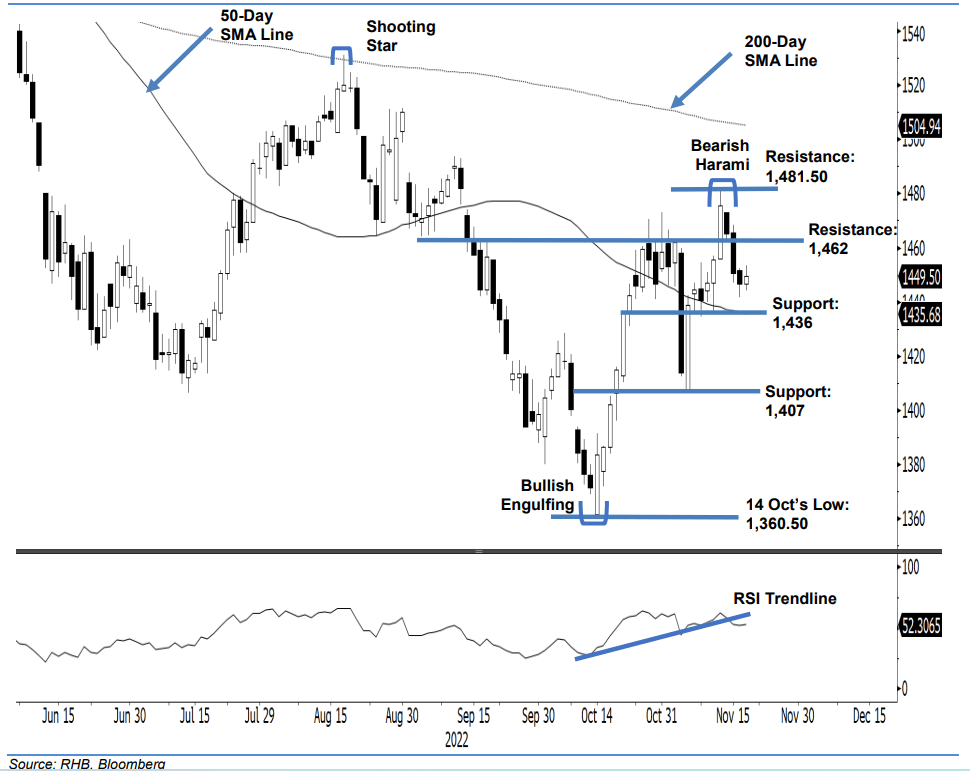
The FKLI struggled to stage a rebound last Thursday as sentiment turned cautious before the market closed for holiday. The benchmark index opened 1,446.50 pts, traded between 1,453.50 pts and 1,444 pts before closing at 1,449.50 pts, with a gain of 3 pts from Wednesday’s session. Despite the bullish candlestick, the RSI has fallen below the trendline – indicating bullish momentum is decelerating.

In the event the index undergoes a correction below the 1,436-pt support or breaches the 50-day SMA line, sentiment would turned negative. In this scenario, the index would retrace towards 1,407 pts. Meanwhile, the bulls may attempt to hold the ground of the moving average line. The research house will maintain a positive trading bias until stop-loss is breached.

Traders should stick to the long positions initiated at 1,475.50 pts or the closing level of 11 Nov. To mitigate the downside risks, the initial stop-loss threshold is set at 1,436 pts.

The immediate support stays at 1,436 pts (10 Nov’s low), followed by 1,407 pts (4 Nov’s low). Conversely, the
immediate resistance is at 1,462 – 2 Nov’s close – then 1,481.50 pts ie the high of 11 Nov.

FTX Collapse Validates View That ‘Centralised Anything Is By Default Suspect,’ Says Buterin

The collapse of FTX contains lessons for all of crypto, according to Ethereum co-founder Vitalik Buterin.

Buterin emphasized the stability of crypto’s so-called underlying technology, the blockchain, while acknowledging the heavy impact of the meltdown of the Sam Bankman-Fried crypto empire. 

In the days since FTX filed for bankruptcy, entities ranging from BlockFi to Genesis to Gemini have been hit by the fallout.

Despite the upheaval, Buterin said blockchain base layers and decentralized-finance protocols worked “flawlessly.”

“What happened at FTX was of course a huge tragedy,” Buterin told Bloomberg. “That said, many in the Ethereum community also see the situation as a validation of things they believed in all along: centralized anything is by default suspect,” he said. These beliefs also included putting one’s trust in “open and transparent code above individual humans,” Fortune.com quoted him saying.

Buterin, like many others in crypto Twitter, has in recent days weighed in on how crypto exchanges could help shore up confidence in their businesses. The downfall of Bankman-Fried has led to an industry-wide self-reckoning over transparency and risk.

Commenting on the earlier collapse of Do Kwon’s TerraUSD algorithmic stablecoin and associated Luna token, Buterin said “crashes like that are on the one hand necessary for the ecosystem.” On the other hand, he added, “I really wish that it happened when Terra/Luna was like 10 times smaller.”

The Battles of Bulls and Bears, HSI Futures Going Through Consolidation

0

RHB Research has maintained long positions.

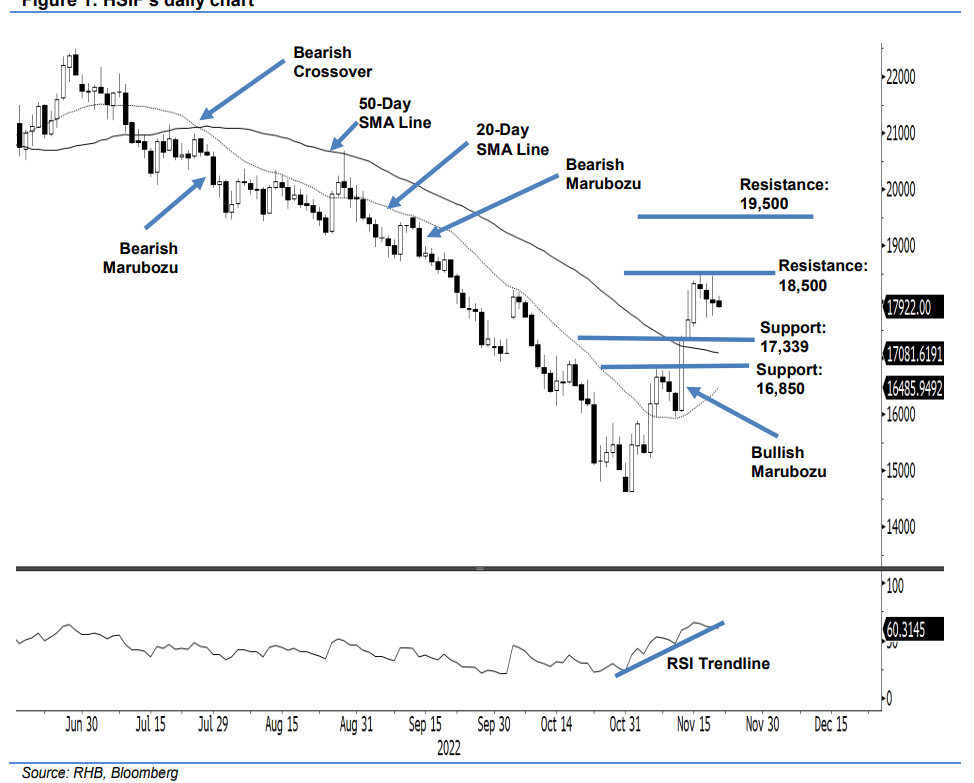
The HSIF momentum is decelerating as the index is undergoing consolidation. Last Friday, after opening at 18,032 pts, the index whipsawed within 18,468 pts and 17,740 pts before it closed at 17,994 pts. It then dipped 72 pts and last traded at 17,922 pts. The long upper and lower shadows showed both bulls and bears shared equal strength. However, the HSIF is still trading above the 50- and 20-day moving average lines – maintaining the bullish posture. If the momentum picks up again, the index should climb and test the 18,500-pt immediate resistance. Otherwise, it will consolidate and retrace towards the 17,339-pt support. During this consolidation phase, the research house still holds on to its positive bias until the stop-loss mark is triggered.


Traders should hold on to the long positions initiated at 16,657 pts or the close of 7 Nov. To manage the downside
risks, the stop-loss threshold is adjusted higher to 16,850 pts from 16,000 pts.

The immediate support sticks at 17,339 pts – 14 Nov’s low – with the lower support at 16,850 pts. Conversely, the
immediate resistance is still pegged at 18,500 pts and followed by 19,500 pts

Stock Picks of the Day: Annum, Wong Engineering

0

Annum

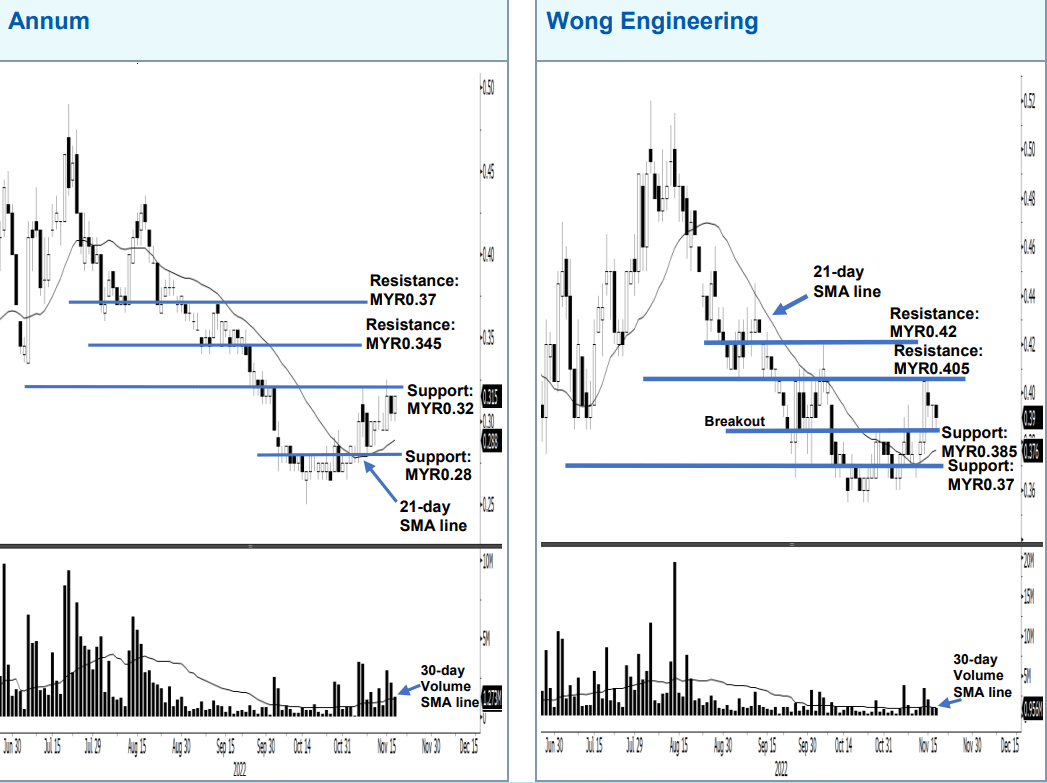
This counter, according to RHB Research’s technical analysis report (Nov 21), is poised for an uptrend reversal as it attempted to move past the immediate resistance of MYR0.32 following a recent rebound above the 21-day average line. If a breakout above that level happens, the stock may push higher towards MYR0.345, followed by MYR0.37 or 13 Sep’s high. Conversely, the stock may trend south if it falls below the MYR0.28 support, forming a “lower low” bearish structure beneath the average line.

Wong Engineering

Wong Engineering is staging a rebound as it recently bounced off the 21-day average line and pushed past the previous resistance of MYR0.385, forming a “higher high” bullish structure. As the stock is supported by partial profit-taking with lower trading volume for the past three sessions – but remaining above the breakout level – the latest “higher low” bullish pattern should indicate that the uptrend reversal pattern is firming up further. Hence, the bulls should push the stock towards the recent high of MYR0.405, followed by MYR0.42 or 6 Oct’s high. The momentum may be reversed if it drops below the strong support of MYR0.37, and trades below the average line.

COP27 Climate Summit: Key Takeaways

This year’s U.N. climate summit featured visits by world leaders, proposals by business leaders, and negotiations by nearly 200 nations about the future of global action on climate change.

Here are some of the key takeaways from the two-week COP27 summit held in the Egyptian resort of Sharm el-Sheikh:

FUND FOR “CLIMATE JUSTICE”

After years of resistance from rich governments, nations for the first time agreed to set up a fund to provide payouts to developing countries that suffer “loss and damage” from climate-driven storms, floods, droughts and wildfires.

Despite being the standout success of the talks, it will likely take several years to hammer out the details over how the fund will be run, including how the money will be dispersed and which countries are likely to be eligible.

FOSSIL FUEL FLOW

The final COP27 deal drew criticism from some quarters for not doing more to rein in climate-damaging emissions, both by setting more ambitious national targets and by scaling back use of fossil fuels such as coal, oil and natural gas.

While the deal text called for efforts to phase down use of unabated coal power and phase-out inefficient fossil fuel subsidies, some countries had pushed to phase out, or at least phase down, all fossil fuels.

But from the opening speeches to the gaveling of the final deal, the use of fossil fuels was affirmed for the near future.

President Sheikh Mohammed bin Zayed al-Nahyan of the United Arab Emirates – host of next year’s COP28 climate summit – said his country would continue to deliver oil and gas “for as long as the world is in need”.

Oil company CEOs were on hand at this year’s summit, after having been pushed to the margins at COP26. Natural gas chiefs were billing themselves as climate champions, despite gas companies having faced lawsuits in the United States over such claims.

Nevertheless, some electricity-poor nations in Africa argued for their right to develop their natural gas reserves, even as they face increasing climate impacts such as drought, Reuters reported.

And fossil fuel phase-out clubs launched around last year’s summit in Glasgow were struggling to recruit new members amid this year’s energy crisis caused by the Ukraine war.

“BRAZIL IS BACK”

Luiz Inacio Lula da Silva was greeted by roaring crowds as he declared “Brazil is back” in the global climate fight, and vowed to host COP30 in 2025 in the Amazon region.

The leftist leader made the Egypt climate summit his first visit abroad since winning Brazil’s presidential election last month against right-wing President Jair Bolsonaro, who presided over mounting destruction of the rainforest and refused to hold the 2019 climate summit originally planned for Brazil.

On Monday, Brazil also joined Indonesia and the Democratic Republic of Congo in launching a partnership to cooperate on forest preservation. The trilateral alliance was negotiated over a decade of on-off talks that continued even as the countries’ national forest policies and leaderships changed. They are expected to press rich nations to pay for forest preservation.

U.S., CHINA RELATIONSHIP REKINDLED

A critical precursor for the climate talks’ success happened far away from the Red Sea locale.

As the COP entered its second week, China’s President Xi Jinping and U.S. President Joe Biden met in Indonesia for the G20 where the heads of the world’s two largest greenhouse gas emitters agreed to restart cooperation on climate change after a months-long hiatus due to tensions over Taiwan.

China’s top climate negotiator Xie Zhenhua had previously told reporters that informal dialogue with John Kerry, his U.S counterpart and a “close friend for 25 years”, had continued.

Xie said on Nov. 19 that he expects to keep up direct cooperation on climate change with Kerry after the end of COP27 – and presumably after Kerry recovers from COVID.

BILLIONS IN PRIVATE FINANCE (BUT NOT TRILLIONS… YET)

The world of finance has failed to provide enough money to help countries cut their carbon emissions and adapt their economies to the changes wrought by global warming, yet the COP27 talks suggest change is coming.

Among the steps likely to free up more cash is a plan to reform leading public lenders such as the World Bank so that they can take more risk and lend more money. By doing so, countries hope more private investors will join in.

Deals struck at the talks also give hope for faster action, chief among them a landmark deal between countries such as the United States and Japan, and private investors to help Indonesia shift away from coal-fired power generation more quickly.

For the latest Business News and happenings, follow BusinessToday on Twitter

Indonesia Caps Minimum Wage Increase At 10% For 2023

0

Indonesia announced a minimum wage increase for 2023 that was smaller than labour unions had demanded, risking protests by workers.

Minimum wages across Indonesia will rise by a maximum of 10 per cent next year, the Ministry of Manpower said, as it set a new formula for computing the increase. Provinces will have until Nov 28 and cities until Dec. 7 to decide minimum wage levels that will come into force on Jan 1.

“With the adjustment of the 2023 minimum wage formula, I hope that people’s purchasing power and consumption will be maintained and can increase economic growth and will eventually create jobs,” Minister Ida Fauziyah said in a Saturday briefing. Bloomberg cited.

The increase falls short of the labour unions’ demand for as high as 25 per cent increase in minimum wages. Unions had urged the government to use a previous rule that would pave way for at least 13 per cent increase and also made a case for a 25 per cent jump citing double-digit food, fuel and housing inflation.

Consumer prices in Indonesia are hovering below 6 per cent, considered relatively low in Asia where neighbours Singapore and the Philippines are grappling with more than 7.5 per cent price growth.

The Confederation of Indonesian Trade Unions had threatened a protest march by five million workers if its demand wasn’t met.

For the latest Business News and happenings, follow BusinessToday on Twitter

Wall Street Wants To Believe Xi’s Money-Minting Markets Are Back

More than two years of growth-squelching policies sent international investors fleeing China. It’s taken all of two weeks to lure them back.

From Morgan Stanley and Bank of America to TCW, Fidelity International and Franklin Templeton, some of the biggest players in global markets are turning increasingly bullish on Chinese assets. It’s a stark contrast from just last month, when foreign firms pulled an estimated $8.8 billion from the nation’s slumping stocks and bonds, and analysts were predicting more gloom ahead.

The dramatic about-face comes as Beijing seemingly shifts toward a more pro-growth footing, tweaking Covid policies to minimize economic and social costs, delivering a plan to rescue the beleaguered property market and dialing back tensions with the West. The result: mainland shares are up more than 8% in November, while the yuan is on pace for its first advance in nine months. With concerns that monetary-policy tightening in the US and Europe could soon tip the developed world into a recession, foreign firms are increasingly looking to China as a key portfolio hedge.

“Investors have to start thinking about what is going to be one of the big, global trades of 2023, which is going to be the China reopening trade,” David Loevinger, a sovereign analyst at TCW Group Inc. and former US Treasury Department senior coordinator for China affairs, said in a podcast last week. “The direction of China’s Covid policy is clear, tail risks are lower, and this is not going to be lockdowns forever.”

That’s not to say that international investors are ready to throw caution to the wind. Plenty of firms that have dialed back their China exposure in recent months have expressed little appetite to ramp it back up anytime soon. There’s concern that the country’s leadership is turning less pragmatic in guiding the world’s second-largest economy, pursuing increasingly ideological policies instead. And relations with the West remain fraught.

But amid the first annual foreign portfolio outflows in more than two decades and one of the nation’s biggest-ever stock-market routs, China’s leadership appears to be, if not acquiescing to the appeals of global investors, at minimum heeding their concerns.

“We’re starting to hear of emerging-market long-onlys looking to build up their onshore capacity,” said Winnie Wu, co-head of China equity research at Bank of America Corp. in Hong Kong. Her team recently turned bullish on Chinese stocks. “As long as the money-making effect is there, investors will return.”

Foreign capital has flocked to China for the better part of a decade as regulatory reforms opened the nation’s domestic markets to global money managers.

Overseas investors have accumulated 3.38 trillion yuan ($475 billion) worth of bonds in the onshore interbank market, according to official data as of October, while about 11% of mainland Chinese shares are held by foreigners, JPMorgan Chase & Co. estimates.

Yet international portfolio outflows across mainland stocks and bonds are on track to exceed an unprecedented $100 billion this year, according to Morgan Stanley, as President Xi Jinping has shown he’s willing to crack down on some of China’s largest companies and sacrifice growth in an effort to rein in debt, reduce income inequality and protect the country from Covid-19.

“It’s important to not sacrifice domestic interests for the sake of internationalization,” Guan Tao, chief economist at BOC Securities and an ex-official at the State Administration of Foreign Exchange, said in an interview. “In opening up its financial markets, China will follow the principle of initiative, gradual progress and control.”

China’s tolerance for economic pain in pursuit of Xi’s goals — like Covid Zero or common prosperity — helped fuel an almost 30% slump in the benchmark CSI 300 Index this year through the end of October. The Hang Seng China Enterprises gauge of mainland companies listed in Hong Kong was down 40%.

“If you’re an international investor, trying to second guess what the authorities are doing is more difficult in an environment where they’re not purely prioritizing economic growth,” Vivek Paul, a senior portfolio strategist at BlackRock Investment Institute, said in a Bloomberg TV interview last week. “What we’ve seen recently are necessary — but not necessarily sufficient — conditions for a strong rebound.”

‘Huge Opportunity’

Still, Chinese asset prices are so beaten down that many Wall Street firms say the balance of risk has become decidedly skewed to the upside.

Morgan Stanley recently boosted its forecast for the country’s stock gauges, predicting the MSCI China Index will rally 14% by the end of next year, while Bank of America turned tactically constructive on the country’s shares.

“We all knew that China couldn’t just be isolated forever,” Catherine Yeung, an investment director at Fidelity International Ltd., said last week in a Bloomberg TV interview. “So much negative news flow has been now factored into the price. It just feels like China is likely to have seen its worst.”

While Beijing is unlikely to pursue a hard decoupling, it’s becoming more wary about the potential risks of foreign investment, according to Victor Gao, chair professor at Soochow University and vice president of think tank Center for China and Globalization. The concern is that greater reliance on overseas funding could leave China vulnerable to harsh restrictions imposed by the West.

“There’s a lot of wariness about what the US is up to now,” said Gao, who worked as an interpreter for former leader Deng Xiaoping in the 1980s. “That’s why China is building a wall.”

Still, the country is likely to continue courting foreign capital in the years ahead.

A narrowing current account will make China “hungrier for global capital” toward the end of the decade, according to Morgan Stanley, requiring at least $150 billion of foreign inflows annually to plug the financing hole.

“We’d like to see the Chinese government being more willing to accept foreign investment and let the markets operate,” Raphael Arndt, chief executive officer of the Future Fund –Australia’s sovereign wealth fund — told Bloomberg TV at the Bloomberg New Economy Forum in Singapore last week. “We think there’s a huge opportunity still.”

For the latest Business News and happenings, follow BusinessToday on Twitter