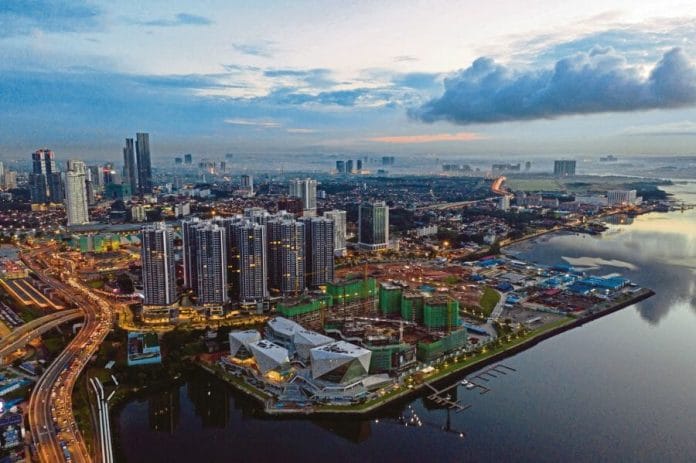
The data centre industry continues to outperform regional peers, with Johor emerging as the Asia-Pacific’s fastest-growing market as the country cements its position as a leading digital infrastructure hub, according to the Knight Frank Data Centre Atlas 2026.
The report found that Johor now boasts the region’s largest incoming data centre pipeline at 8,542 megawatts (MW) and the lowest co-location vacancy rate of just 0.7%, highlighting exceptionally strong demand from hyperscale operators and enterprise customers.
Johor’s data centre market is valued at US$39.11 billion (RM159.9 billion), making it the second-largest in Asia-Pacific after Japan. The state also recorded a live IT capacity of 1,110MW, ranking third in the region behind Tokyo (1,473MW) and Singapore (1,118MW).
Keith Ooi, Group Managing Director of Knight Frank Malaysia, said Malaysia’s growing prominence as a regional data centre destination is being reinforced by its stable investment environment amid global geopolitical uncertainty.
“Malaysia’s emergence as a regional data centre hub comes as ongoing tensions in the Middle East place emphasis on policy stability, predictable investment conditions and operational resilience for investors, particularly as operators review regional deployment risk,” he said.
Johor attracts RM1.02 billion in new investments
Johor continued to attract significant investor interest, recording RM1.02 billion worth of disclosed data centre-related land transactions involving 163.6 acres during the first half of 2026.
The report noted that while new project announcements have moderated from the rapid pace seen in recent years, investment momentum remains healthy.
Among the key developments was a RM12.7 billion investment commitment by an Australian hyperscale specialist to build two new data centres in Johor, adding 280MW of new capacity.
Knight Frank Executive Director of Valuation & Advisory Justin Chee said Johor has evolved beyond being merely an extension of Singapore’s data centre ecosystem.
“What began as a secondary market to Singapore has matured into a fully institutionalised market, supported by significant regional and global capital inflows,” he said.
While Johor continues to enjoy cost advantages in land and electricity, Chee noted that rising utility tariffs are gradually narrowing that gap.
Annual electricity costs for a typical 50MW facility can now reach around RM120 million, prompting operators to invest more heavily in renewable energy and alternative power solutions.
To support sustainable growth, the Johor Government has established a Special Technical Committee to evaluate new data centre developments based on electricity demand, water requirements, infrastructure readiness and site suitability.
Klang Valley sees investment rebound
Meanwhile, the Klang Valley also recorded a strong recovery in investment activity.
Knight Frank said the region registered RM1.4 billion in disclosed data centre transactions covering 293.1 acres during the first half of 2026, rebounding from a subdued second half of 2025.
The resurgence follows several policy initiatives introduced by the Selangor Government, including the RM160 million Digital Future Action Plan 2026-2030 and a local economic development policy requiring new data centre projects to achieve at least 30% local content participation.
Chee said the continued expansion of data centres in Selangor and Kuala Lumpur reflects robust demand from operators while encouraging greater participation from Malaysian developers and state-linked corporations.
“New and ongoing data centre developments in Selangor and Kuala Lumpur reflect strong demand by operators and tenants, as well as the broader involvement of local developers and state-linked corporations in developing, constructing and investing into these new data centre locations as new data centre urban nodes,” he said.
Growth spreads beyond traditional hubs
As Malaysia’s data centre ecosystem matures, investment interest is beginning to extend beyond Johor and the Klang Valley.
Knight Frank highlighted several major proposals announced recently, including a US$1.1 billion (RM4.1 billion) artificial intelligence (AI) data centre project and a separate RM9 billion data centre investment in Jasin, Melaka, as well as a RM1 billion AI park development in Perak.
Although many of these projects remain at the planning or early implementation stage, the report said they reflect growing investor confidence in alternative locations as demand for digital infrastructure expands across the country.
With strong investor appetite, continued government support and rising regional demand for cloud computing and AI infrastructure, Knight Frank expects Malaysia to remain one of Asia-Pacific’s fastest-growing data centre markets in the years ahead.